Doug tried one last time before stepping onto the porch.
“You’ll regret this,” he said. “When you need help, when the bills pile up, when you’re drowning, don’t come crying to us.”
Scott stood beside the open door.
“I wouldn’t dream of it.”
Marlene clutched her purse with both hands.
“We’re your family.”
Scott looked at the two people who had given him life but had never learned how to care for it.
“No,” he said. “Family does not choose dinner over a child’s breathing.”
Doug’s mouth tightened.
Marlene made a sound like she had been hurt.
For a moment, Scott felt grief rise in his chest.
Not grief for losing them.
Grief for the parents they should have been.
Then Doug grabbed his jacket, Marlene gathered her purse, and they walked down the porch steps.
Scott watched them load their things into the trunk. They sat in the car for nearly a minute, Marlene bowed over her lap, Doug staring through the windshield like pride could somehow drive them back into the house.
Then the engine started.
The car pulled away.
Scott closed the door.
Locked it.
Slid the deadbolt home.
The click sounded louder than it should have.
For a long time, he stood with his hand still on the lock.
The house was quiet.
Properly quiet.
No television blaring after Laya’s bedtime. No comments from Marlene about how Scott cooked too plainly. No sighs from Doug when Laya left crayons on the table. No heavy, invisible tension humming under every room.
Scott let out a breath he felt like he had been holding since childhood.
Then he began cleaning.
Not because the house was messy.
Because he needed them gone in every way.
He threw away the coffee mugs they had left on the side table. He gathered Marlene’s magazines, Doug’s aftershave, the decorative pillow his mother had bought without asking, the framed childhood photos she had placed in the hallway as if she could rewrite the past with smiling pictures.
All of it went into trash bags.
In the guest room, he stripped the bed completely and opened the window to let in the cold desert air.
By dawn, the room looked empty.
Clean.
His again.
Scott checked on Laya.
She was asleep with Copper tucked beneath one arm, her breathing soft and even. The sight almost brought him to his knees.
He pulled the small chair from her desk and sat beside her bed as the first pale light crept across the floor.
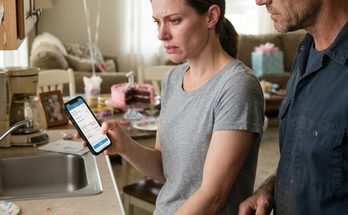
His phone buzzed.
A text from his mother.
It was long.
He read the first few lines.
How hurt she was.
How unreasonable he was being.
How they had always tried their best.
How he was breaking his father’s heart.
There was nothing about Laya’s breathing.
Nothing about the doctor’s warning.
Nothing that sounded like real remorse.
Years ago, Scott would have read every word twice, looking for a hidden apology. He would have drafted careful replies, trying to make them understand without making them angry.
That man was gone.
He blocked her number.
Then his father’s.
Then he deleted them from his emergency contacts, school forms, medical forms, and every place where he had once written their names under the word family.
It took less than five minutes.
Sunday morning came warm and bright.
Laya appeared in the kitchen doorway around 9:30, hair tangled, Copper dangling from one hand.
“Daddy?”
Scott turned from the sink.
“Hey, baby. How do you feel?”
“Okay. My throat feels funny.”
“That’s from the medicine. It’ll get better.”
She climbed into a chair.
“Can I have pancakes?”
“I already planned on it.”
He pulled out the mixing bowl, flour, sugar, baking powder, chocolate chips.
The ordinary rhythm of breakfast felt almost sacred.
Halfway through stirring, Laya asked the question he had known was coming.
“Where did Grandma and Grandpa go?”
Scott set the spoon down and sat across from her.
“They went back to their house.”
“Why?”
He chose each word carefully.
“They made choices that were not safe for you. When someone puts you in danger, even if they say they love you, we have to protect ourselves from that happening again.”
Laya frowned.
“Because I got sick?”
“Because they knew you needed medicine and did not get it.”
“Oh.”
She looked down at Copper’s ears and thought.
“Are they coming back?”
“No, baby.”
“Ever?”
Scott held her gaze.
“Not ever.”
He waited for tears.
Instead, Laya nodded slowly.
“Grandma said my toys were too loud sometimes.”
Scott went still.
“She did?”
“And Grandpa got mad when I left crayons on the table. He said I was messy.”
Scott’s jaw tightened.
“You are six. Six-year-olds are supposed to have toys and crayons.”
“That’s what I thought.”
She smiled at him.
A small, relieved smile.
“Are we okay now? Just us?”
Scott reached across the table and touched her hand.
“We’re better than okay.”
“Good. Can my pancakes have chocolate chips?”
“Always.”
That afternoon, their neighbor Rosa knocked on the door.
Rosa was a retired teacher who lived three houses down and had occasionally watched Laya when Scott’s work schedule got ugly.
“I saw your parents leave very early,” she said. “Is everything all right?”
Scott considered giving a polite answer.
Then he realized he was done protecting people who had never protected him.
“They endangered Laya,” he said. “They are not welcome here anymore.”
Rosa’s expression changed, but she did not pry.
“Is Laya okay?”
“She is now.”
“And are you okay?”
That question surprised him.
People asked about the child.
About the crisis.
About the conflict.
Almost no one asked about him.
Scott thought about it.
“Yeah,” he said. “I actually am.”
Rosa nodded.
“For what it’s worth, I never cared much for the way they looked at that little girl. Like they were always keeping score.”
Scott felt something loosen in his chest.
“Thank you.”
“If you need help, real help, you know where I am.”
That week, Scott rebuilt the routine.
Pharmacy first thing Monday. A follow-up appointment with Dr. Morrison. New medication schedule taped inside the kitchen cabinet. Back-up inhaler for school. Back-up plan with Rosa.
No loose ends.
No depending on people who treated responsibility like a favor.
Unknown numbers kept calling.
Doug once.
Marlene twice.
A cousin Scott barely spoke to.
He blocked them all.
A certified letter arrived the next Friday.
Three pages in Marlene’s careful handwriting.
She was hurt.
She was disappointed.
She and Doug had done their best.
They were willing to forgive him if he apologized.
Scott read it once, then again.
Still no mention of Laya gasping in his arms.
No mention of the red circle around immediate danger.
No sentence that began with, We were wrong.
He fed the letter into the shredder and watched it become thin white strips.
On Saturday, he took Laya to the park.
She ran toward the swings with Copper under one arm, laughing in the open desert sunlight. Scott sat on a bench and watched her play until another parent sat beside him.
“Your daughter’s sweet,” the woman said. “Very polite.”
“Thank you.”
“I’m Amanda. My son’s the one in the red shirt.”
“Scott.”
They watched the children for a while.
Then Amanda said, lightly but kindly, “No grandparents helping with the weekend chaos?”
Scott looked at Laya climbing the monkey bars.
“No. Just me.”
“That must be hard.”
He thought about that.
Being a single father was hard.
Working long hours was hard.
Paying medical bills was hard.
But it was easier than letting unsafe people into his daughter’s life just so his own burden felt lighter.
“It’s honest,” he said. “That’s better than easy.”
Amanda seemed to understand.
They exchanged numbers before leaving.
Not as a promise.
Just as a possibility.
That felt new.
Two weeks later, Scott stood in the kitchen making dinner while Laya did homework at the table.
The hallway wall still had empty spaces where family photos used to hang. He had kept the pictures of Janet. The ones of Laya as a baby. A few of the three of them before everything changed.
The rest were gone.
The empty wall did not feel sad.
It felt available.
“Daddy,” Laya said.
“Yeah, baby?”
“Can Copper have a friend?”
“What kind of friend?”
“Maybe a bear. Or a bunny. For his birthday.”
Scott smiled.
“When is Copper’s birthday?”
She thought very seriously.
“Next week.”
“Then next week, Copper gets a friend.”
After dinner, bath time, and three chapters from her favorite book, Scott tucked her into bed.
“I love you,” he said.
“I love you too, Daddy.”
She yawned.
“We’re a good team.”
“The best team.”
When she fell asleep, Scott stood in her doorway and listened to her breathe.
Clear.
Even.
Safe.
Later, he went onto the front porch.
The desert wind smelled of sage and dust. Stars filled the sky above the quiet neighborhood.
Some people would call him harsh.
Some would say family deserved forgiveness.
Some would call it one mistake.
Those people had not watched their child fight for air while the adults who promised to help chose steak and laughter instead.
Scott did not need them to understand.
He went back inside, locked the door, and turned off the porch light.
For the first time in weeks, the house felt like home.
Not because it was perfect.
Because the only people inside it were safe for each other.