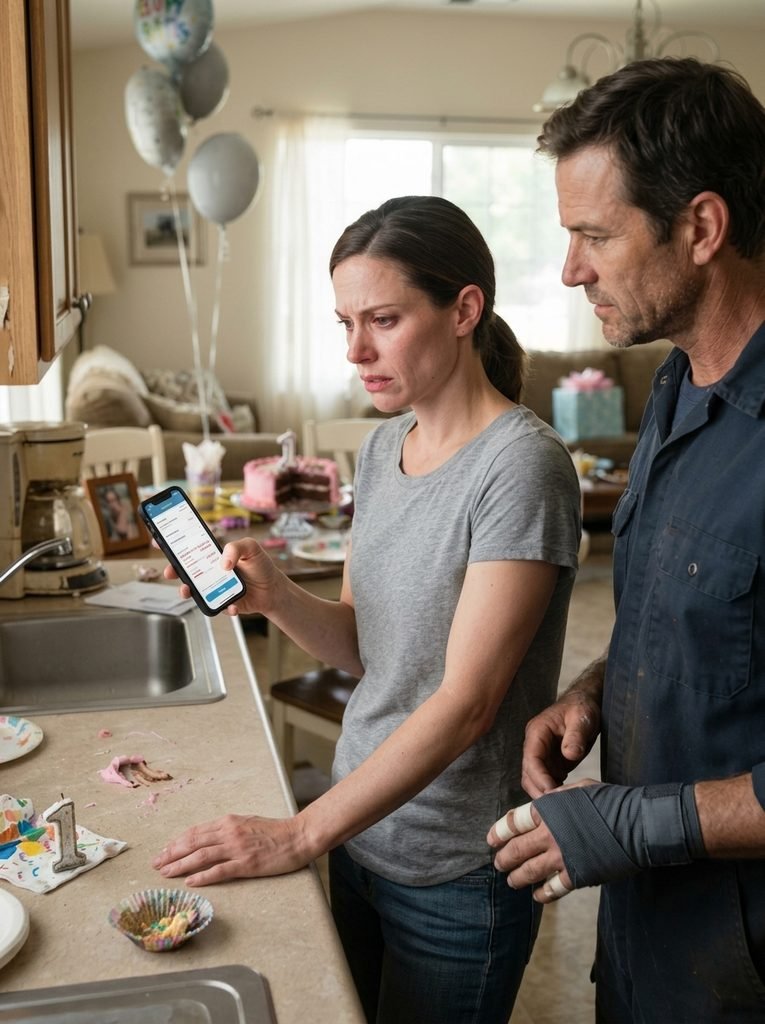
Danny’s message contained seven words.
“Don’t send it yet. Call me first.”
Marcus read it over my shoulder.
“Your call,” he said.
I pressed Danny’s name.
He answered immediately.
“Sarah, are you really giving Mom and Dad five-fifty every week?”
I didn’t answer at first.
His voice changed.
“Oh my God. You are.”
“They said they needed help.”
Danny was quiet long enough for me to hear kids laughing somewhere behind him.
Then he said, “I knew you helped sometimes. I did not know you were paying their bills every week.”
My grip tightened around the phone.
“They’re at your house right now.”
“I know. Mom told me they wanted to come because they ‘hardly get time with the grandkids.’ She never mentioned Lily’s birthday.”
That hurt in a completely different way.
Not because Danny had stolen them.
Because nobody had forced them to choose.
They had chosen.
Danny exhaled.
“Sarah, don’t delete your message.”
Marcus looked at me.
Danny continued.
“But add me to it.”
“Why?”
“Because if Dad tells everyone you’re being cruel, I’m not sitting here pretending I didn’t hear what really happened.”
I looked at Lily’s empty birthday chair.
Then I added Danny’s screenshot to nothing.
I didn’t need another piece of evidence.
I needed my own decision.
I pressed Send.
Three dots appeared almost instantly.
Then Dad’s reply filled the group chat.
“Fine. If Sarah wants to tell the family about money, maybe it’s time everyone hears why she owed us in the first place.”
For several seconds, nobody answered.
Then Aunt Carol sent a question mark.
One cousin typed, “Owed you?”
Mom jumped in before Dad could explain.
“This should have stayed private.”
I stared at that sentence.
Apparently the money had been private when it benefited them.
The moment I stopped paying, privacy became a principle.
Dad began typing again.
“You people don’t know everything we did for Sarah growing up.”
Marcus leaned against the counter beside me.
“Here it comes,” he said quietly.
I already knew what Dad was going to say.
I had heard versions of it all my life.
They paid for school clothes.
They fed me.
Dad worked overtime when I needed braces.
Mom stayed home with me when I had the flu in third grade.
They helped me buy my first used car.
They were my parents.
Every ordinary act of raising a child had slowly become a ledger in Dad’s mind.
He posted three paragraphs.
By the end, he had turned my childhood into a loan agreement I had somehow signed before I was old enough to drive.
“We sacrificed for her for years,” he wrote. “When she finally started doing well, she offered to help us. That was her way of giving back. Now she’s pretending we stole from her because we missed one birthday party.”
That was the version he wanted everyone to remember.
One birthday.
One misunderstanding.
One oversensitive daughter.
Not $550 every Friday for three years.
Not the car.
Not the phones.
Not the credit card.
Not Lily asking why Grandma and Grandpa had not come after promising they would.
And definitely not his sentence.
We don’t count your family the same way.
Danny replied before I could.
“Dad, raising your own kid is not a debt she owes you.”
The chat exploded.
One aunt wrote, “Exactly.”
Another said everyone needed to calm down.
A cousin sent the digital equivalent of backing slowly out of the room.
Mom called me again.
I declined it.
She called a second time.
I declined that too.
Then a text came through.
“Please answer. Your father is upset.”
I showed Marcus.
He gave me a tired little smile.
“Everybody in this house has been upset today.”
That did it.
I laughed.
Not because anything was funny.
Because my husband had worked two shifts, helped hang paper streamers after midnight, cleaned chocolate frosting off the floor, watched his daughter stare at an empty doorway, and somehow he was still the person expected to absorb the least attention.
I had been taking money out of our household every week to preserve my parents’ comfort while the man beside me quietly repaired Lily’s shoes with duct tape.
I walked down the hallway.
Lily was asleep sideways across her bed, still wearing one purple sock.
The glitter on her cheek had smeared onto the pillowcase.
On her dresser sat the birthday card Marcus and I had given her.
She had drawn three stick figures inside afterward.
Mom.
Dad.
Lily.
No grandparents.
No dramatic black scribbles.
No angry faces.
Just the three people who had been there.
I returned to the kitchen and opened my banking app again.
For the first time, I calculated what three years of Friday transfers actually meant.
Fifty-two Fridays a year.
Five hundred fifty dollars each.
The total made my stomach tighten.
More than $85,000 had left my account in regular transfers alone.
That did not include the phone bills.
It did not include charges on the emergency card.
It did not include the difference between what my parents paid on the car and what I covered when they were short.
Marcus stared at the number.
He didn’t say, “I told you so.”
That somehow made it worse.
“I’m sorry,” I whispered.
He shook his head.
“No.”
“I should’ve listened to you.”
“I wanted you to listen to us.”
The word us landed harder.
Not me.
Us.
Our daughter.
Our rent.
Our groceries.
Our future.
For years, every time my parents needed something, I had treated our household like the flexible one.
We could wait.
We could put groceries on a card.
We could drive the car another six months.
Lily could wear the sneakers a little longer.
Marcus could take another shift.
Sarah could figure it out.
My parents, meanwhile, needed to “live comfortably.”
I realized I had never once used that phrase for my own family.
That night, I moved the $550 that would have gone out the following Friday into a separate savings account.
I labeled it simply: HOME.
Not revenge.
Not Mom and Dad.
HOME.
The next morning, Mom arrived at our apartment without calling.
Marcus opened the door but did not move aside.
I was standing behind him.
Mom held her purse against her body with both hands.
Her face looked tired.
“Can I come in?”
I hesitated.
Then Lily appeared at the hallway entrance.
Mom’s expression changed.
“Sweetheart.”
Lily stayed where she was.
Children notice more than adults want to believe.
“Why didn’t you come to my birthday?”
Mom’s mouth opened.
No sound came out.
Lily looked at me.
I could have rescued Mom.
I had been doing that my entire life.
Instead, I waited.
Mom crouched down.
“We made a bad choice.”
It was not the polished apology I would have written for her.
Maybe that was why I believed it.
Lily asked, “Did you forget?”
Mom swallowed.
“No.”
That answer cost her something.
“We didn’t forget.”
Lily looked confused.
“Then why?”
Mom’s eyes filled.
“Because Grandma made the wrong choice.”
Dad would have blamed traffic.
Scheduling.
Danny.
Me.
Mom didn’t.
Lily nodded the way children sometimes do when an explanation is too heavy to understand but simple enough to remember.
Then she went back to her room.
Mom stood.
“I need to talk to you.”
Marcus looked at me.
I nodded.
We sat at the kitchen table beneath one leftover pink streamer I still had not taken down.
Mom looked at the empty cake box.
“I didn’t know your father said that.”
“You heard enough.”
“I knew he said Danny’s family was easier.”
“That isn’t better.”
“No.”
She rubbed her thumb against the edge of her purse.
Then she said, “We have been unfair to you.”
It was the closest my mother had ever come to saying the thing without adding a reason afterward.
I waited.
“We got used to the money.”
There it was.
Not need.
Not survival.
Used to it.
“At first, we really were struggling,” she said. “Your father’s hours had been cut. I wasn’t getting enough clients. What you sent helped.”
“I know.”
“But then things got better.”
I looked at her.
“How much better?”
She stared at the table.
“Enough that we should have talked to you.”
Marcus went completely still beside me.
“How long?” I asked.
Mom’s answer was barely above a whisper.
“More than a year.”
I leaned back.
For more than a year, Lily had worn bargain shoes until the soles separated.
For more than a year, Marcus had worked extra shifts.
For more than a year, I had carried groceries to the register with a calculator open on my phone.
All while my parents could have said one sentence.
We’re okay now.
“You let me keep sending it.”
Mom nodded.
“We told ourselves you could afford it.”
I laughed once.
It was a hard sound.
“You never asked.”
“No.”
“You knew I had a child.”
“Yes.”
“You knew Marcus was working two jobs.”
“Yes.”
“Did you know our rent was late?”
Her face answered before her mouth did.
“You did.”
“I knew money was tight.”
“And you kept taking $550 every Friday.”
She started crying.
I felt almost nothing at first.
Then the guilt arrived.
Automatic.
Old.
Powerful.
I had spent years treating my mother’s tears like an emergency alarm.
I started to reach across the table.
Then Marcus’s hand rested quietly beside mine.
Not grabbing me.
Not stopping me.
Just there.
I left my hand where it was.
Mom wiped her face.
“Your father is furious with me for coming.”
“That’s his problem.”
“He says you embarrassed us.”
“I showed people what I paid.”
“He says family matters shouldn’t be public.”
“Dad made our place in the family public when he told me we didn’t count the same.”
She looked down.
For once, she had no answer.
I told her the transfer was not coming back.
The phone lines were not coming back.
The emergency card was staying frozen.
The car loan was their responsibility.
“If something serious happens,” I said, “you can tell me, and I’ll decide whether I can help.”
Mom nodded weakly.
“But there will never again be an automatic payment from my house into yours.”
Her face tightened at the word never.
I let it.
Some boundaries only become boundaries when they survive another person’s disappointment.
Dad did not call for eleven days.
He posted vague things online about disrespectful adult children and parents being forgotten after sacrifice.
I stopped reading them.
Then one Friday morning, I woke at 8:57.
For three years, I had known what happened at nine.
I made coffee and watched the clock change.
8:58.
8:59.
9:00.
Nothing left my account.
No $550.
No familiar transaction.
No little dip in the balance followed by my usual justification.
Nothing.
I thought I would feel victorious.
Instead, I felt sad.
The transfer had once meant love to me.
That was the part I had been afraid to admit.
Canceling it felt like accepting that money had been carrying a relationship long after the relationship had stopped carrying me.
At 9:12, Marcus walked into the kitchen.
He looked at my phone.
“Still there?”
I nodded.
He opened the refrigerator.
“We need milk.”
I laughed.
That Friday we did something embarrassingly ordinary.
We bought groceries with cash instead of putting them on the card.
Chicken.
Rice.
Milk.
Apples.
Cereal Lily liked.
Coffee that wasn’t the cheapest can on the shelf.
Then we drove to a shoe store.
Lily tried on a pair of purple sneakers.
She ran up and down the aisle once.
Then twice.
“Do they pinch?” I asked.
She shook her head.
“Jump.”
She jumped.
Marcus crouched and pressed his thumb against the toe to check the fit.
Lily looked down at him.
“No tape?”
Marcus smiled.
“No tape.”
She grinned.
I had to turn away for a second.
The shoes cost less than one tenth of what I had been sending my parents every Friday.
That number stayed with me all afternoon.
I started looking differently at every expense I had once called selfish.
Lily’s school pictures.
An oil change before the warning light came on.
Replacing Marcus’s worn work boots before the soles split.
Building an emergency fund.
Paying down the grocery card.
None of those things were luxury.
They were the life I had been underfunding to protect people who openly admitted they valued it less.
Danny called two weeks later.
He apologized.
I told him he had not been responsible for our parents’ choice.
“I know,” he said. “But I think I liked not knowing.”
That was more self-aware than I expected.
He told me Mom and Dad had stopped visiting him as often after the group chat argument.
Apparently being the favored branch of the family was less comfortable once everyone acknowledged it.
“I also told Dad not to use my kids as an excuse anymore,” Danny said.
“Good.”
“He didn’t like that.”
“I’m shocked.”
Danny laughed.
It was the first normal conversation we had had in years.
Not especially close.
Not suddenly healed.
Just honest.
That was enough.
Mom started visiting Lily occasionally.
At first, I made the visits short.
No promises she could not keep.
No dropping in unannounced.
No criticizing Marcus.
No conversations about money in front of Lily.
And if Mom said she would come at two, I expected her at two.
The first time she canceled, she called Lily herself.
She apologized herself.
She did not ask me to invent an excuse.
That mattered.
Dad stayed away longer.
Nearly three months.
Then one evening, he appeared outside while Marcus and Lily were drawing with sidewalk chalk.
He stood at the edge of the parking area with his hands shoved into his jacket.
Marcus saw him first.
He looked at me through the window.
I went outside alone.
Dad did not say hello.
“You really done helping us?”
I almost smiled at how perfectly Dad he was being.
“No.”
His eyebrows lifted.
“I’m done being responsible for you.”
“That sounds like the same thing.”
“It isn’t.”
I stepped closer.
“If you’re hungry, tell me.”
He looked away.
“If the heat breaks in January and you truly can’t fix it, call me.”
He said nothing.
“If Mom needs a ride somewhere important, ask.”
Then I said the part he needed to hear.
“But I am never again paying you for being my parents.”
His jaw tightened.
“I never said that’s what it was.”
“You told the family I owed you because you raised me.”
He looked toward the sidewalk where Lily was filling a chalk heart with purple.
“Parents sacrifice.”
“Yes.”
“We gave things up.”
“I know.”
“And you think that means nothing?”
“No.”
I shook my head.
“I think it meant you were my parents.”
That finally quieted him.
He watched Lily for several seconds.
Then he said, “I shouldn’t have said your family counted differently.”
“No.”
“I was angry.”
“That doesn’t make it untrue.”
He looked at me.
For the first time, I saw uncertainty instead of authority.
Maybe he had expected an argument he could win.
A list he could answer.
A price he could calculate.
Instead, there was only the consequence.
“If you want a relationship with Lily,” I said, “then have one because she matters to you.”
He swallowed.
“Not because I pay you.”
His eyes dropped.
“No.”
“And not because Danny’s kids are busy that weekend.”
He flinched.
Good.
Some sentences are supposed to hurt.
Not because cruelty is useful.
Because truth sometimes reaches places politeness never does.
Dad did not apologize beautifully.
He did not cry.
He did not suddenly become a different man.
He nodded once.
Then he walked over to the sidewalk and stopped several feet from Lily.
“Hey, kiddo.”
Lily looked up.
“Grandpa.”
He pointed at the chalk.
“What are you making?”
“A house.”
“Whose house?”
“Ours.”
Dad glanced at me.
Then back at her.
“Looks good.”
That was how he came back.
Not with a speech.
With twenty minutes on the sidewalk drawing a crooked chimney beside his granddaughter.
I did not mistake twenty minutes for repair.
But I did not reject it because it was small.
Small was how most of the damage had happened too.
One excuse.
One missed visit.
One favor assumed instead of requested.
One Friday transfer becoming fifty, then a hundred, then more.
So repair could be small as well.
One visit kept.
One apology without a defense.
One birthday remembered because Lily mattered, not because money was attached.
Nearly a year after the birthday they missed, Friday mornings had changed completely.
Nine o’clock no longer belonged to my parents.
The automatic transfer now went into three places.
Part into our emergency savings.
Part toward debt.
And a smaller amount into an account Marcus and I opened for Lily.
The first time I showed him the balance, he stared at it.
“We did that?”
“We did.”
The emphasis mattered.
Not I.
We.
On Lily’s seventh birthday, Mom arrived fourteen minutes early.
She carried a small gift bag and a grocery-store bouquet Lily immediately tried to smell all at once.
Dad arrived five minutes later holding a card.
No grand entrance.
No expensive present.
No attempt to buy forgiveness.
Danny and his family came too.
Our apartment was crowded.
The cake was chocolate again.
The frosting was pink because according to Lily, she had still not changed her scientific position that pink tasted better.
When it was time to sing, I looked around the table.
Marcus stood beside me.
His hands were still rough from work, but he was down to one job and occasional overtime.
Lily wore her purple sneakers even though they were getting tight.
Mom held the paper plates.
Dad stood behind Lily’s chair.
Danny’s youngest had frosting on his nose.
Nobody was ranking anybody.
Nobody was talking about who was more established.
Nobody had been paid to be there.
Lily blew out seven candles in one breath.
Everyone cheered.
Later, after the dishes were stacked and the last guest had left, I found Dad standing beside the cake table.
He was looking at the two chairs from the old folding set.
The same kind of chairs that had sat empty the year before.
“You remember?” I asked.
He nodded.
“Yes.”
That was all.
No excuse.
I appreciated that more than an excuse.
He picked up one of the chairs and carried it to the closet.
Before leaving, he stopped by the door.
“See you next week?”
I looked at him.
He was asking.
Not announcing.
Not assuming.
“As long as you call first.”
He nodded.
“I will.”
Then he left.
Marcus began gathering stray wrapping paper.
Lily sat on the floor sorting her new markers by color.
I opened my phone.
It was Friday evening.
The HOME account had grown enough that our next emergency would not have to become a catastrophe.
The credit card balance was almost gone.
Lily’s savings account had more money in it than I had possessed at her age.
I thought about those old Friday mornings when $550 disappeared and I told myself the ache in my stomach was what being a good daughter felt like.
I know better now.
Helping people you love should not require making the people who depend on you live with less dignity.
And boundaries do not erase generosity.
They tell generosity where home is.
I locked my phone and slid it onto the counter.
Across the room, Lily held up a marker.
“Mom, pink or purple?”
“For what?”
She pointed to the picture she was drawing.
It was another house.
Three people stood in front of it.
Then, after a moment, she added two smaller figures off to one side.
Grandma and Grandpa.
Not inside.
Not gone.
Just there because she had chosen to put them there.
“Purple,” I said.
She nodded seriously and uncapped the marker.
The following Friday at nine in the morning, my phone buzzed.
For one old, instinctive second, my stomach tightened.
Then I looked.
$550 had moved automatically.
But this time, none of it had left my family.
And that was the first Friday in years when the number finally meant what I had always wanted it to mean.
We were taking care of our own.