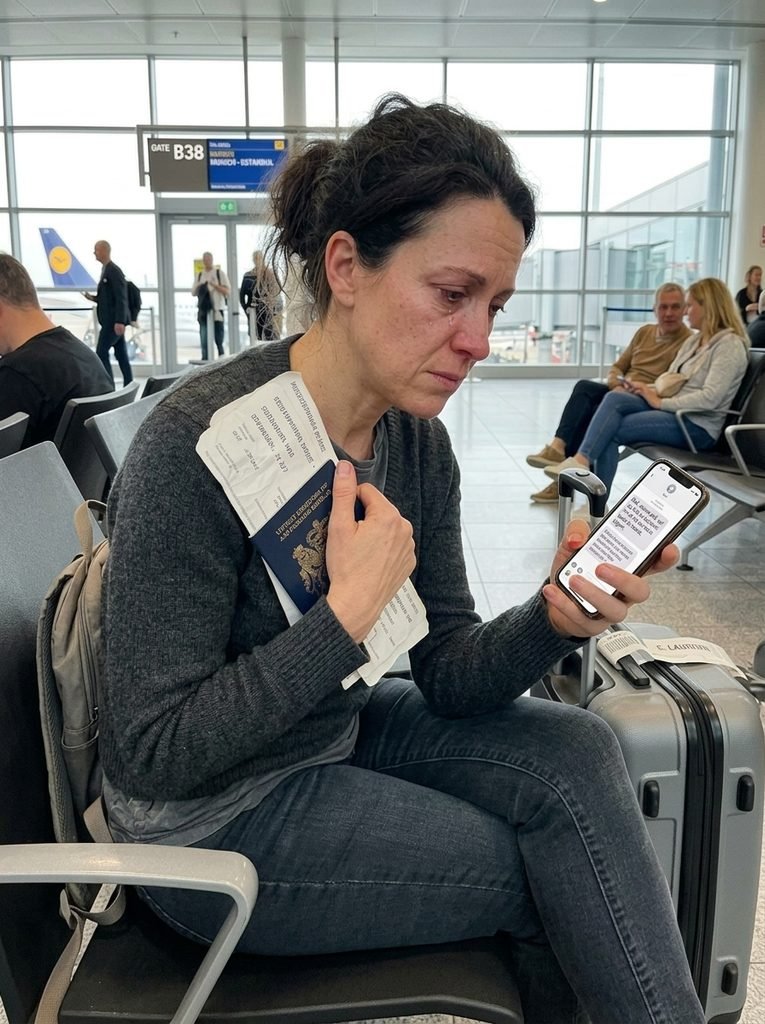
The security alert appeared just after Clara closed her laptop at the airport. The access code to the $966,000 coastal home she had bought for her parents had been changed, even though they were supposed to be leaving for Europe. She opened the security app, tapped the live feed, and waited for the image to load.
What she saw made her stop breathing for a second.
Someone was inside the house.
Image
And Clara knew exactly who was supposed to have been there—and who absolutely was not.
Just hours earlier, she had been standing inside the Delta international terminal with a passport in one hand and $30,000 worth of Mediterranean cruise tickets in the other. She had paid for the trip because she thought it might finally give her family something they had been missing for years: time together without bills, arguments, work, or old resentment getting in the way.
She had planned the whole thing down to the smallest detail.
Private excursions in Santorini. Sunset dinners in Mykonos. Comfortable rooms. Extra packages. The kind of vacation people save for years to experience once.
Clara had not saved for it.
She had simply paid for it.
That was what she did for her family.
She paid.
She fixed things.
She stepped in when money got tight.
She made problems disappear before anyone else had to admit they existed.
For years, she told herself that was what love looked like. If her parents needed help, she helped. If a bill came due, she covered it. If something important was out of reach, she found a way to make it possible.
She never kept a running list of favors.
At least, she tried not to.
But there was one thing she had never expected to have to buy: a place in her own family.
Months earlier, her parents had been struggling to keep their home. The situation had become serious enough that Clara decided to do something neither of them could afford on their own.
She bought them a coastal home worth $966,000.
She did not do it because they had demanded one. She did it because she believed giving them security might change everything between them.
Maybe, she thought, once the financial pressure was gone, they would have room to be happy together.
Maybe they would finally see her differently.
Maybe they would stop treating her like the relative who was useful when there was a problem and inconvenient when there wasn’t.
She was wrong.
The message from her mother arrived while Clara was at the terminal.
“You are not coming. Dad wants this trip to be just family. We gave your ticket to Serena’s sister.”
Clara stared at the screen.
She read it once.
Then again.
The words did not change.
She was not invited.
Her ticket had been given away.
And the reason was that her father wanted the trip to be “just family.”
Clara looked down at the cruise tickets in her hand.
She had paid for them.
She had planned the excursions.
She had arranged the expensive extras.
She had made the entire trip possible.
Yet somehow, she was the person who did not count as family.
She called her mother immediately.
Julian answered.
Her brother sounded almost amused.
“Well, look who finally remembered us.”
Clara asked where her ticket was and why it had been given away.
Julian sighed as though she were making a problem out of something simple.
“Stop being selfish. Serena’s sister needs this vacation more. Besides, you always talk about work. You ruin the mood.”
That sentence stayed with Clara.
Not because it was crueler than everything else they had said.
Because it explained so much.
She had always been welcome when her work could solve something.
Her work was impressive when someone needed money.
Her success was useful when there was a bill.
But the moment she expected respect, the same success became something they could mock.
“I paid $30,000 for this trip,” Clara said.
Julian laughed.
“Your money? Please. You just decorate houses for wealthy people.”
Clara stood there surrounded by travelers pulling luggage behind them while the airport moved normally around her.
People were heading toward gates.
Families were checking passports.
Couples were talking about their vacations.
And Clara was realizing that her own family had apparently decided she was valuable only when she was paying for theirs.
She thought about the house.
She thought about the cruise.
She thought about every expense she had quietly covered because she did not want her parents to worry.
Then her mother took the phone from Julian.
“Clara, calm down,” she said.
Clara asked the one question she had been trying not to ask.
“Mom… did you just say I’m not family?”
Her mother told her not to twist her words.
Then she said something even worse.
Her parents wanted a peaceful vacation without constantly hearing about everything Clara had done for them.
That was the moment something inside Clara finally shifted.
They did not hate her money.
They hated being reminded that the money had come from her.
For years, Clara had mistaken usefulness for belonging.
She had believed that if she helped enough, fixed enough, and paid enough, her parents would eventually stop making her feel like an outsider.
Instead, she had made herself indispensable without ever becoming respected.
Clara lowered the phone.
She ended the call.
Then she opened her laptop.
She logged into the cruise account and checked the payment authorization.
Every luxury room, package, excursion, and expensive extra was still connected to the card she had personally authorized.
Her thumb rested over the trackpad.
She could have done nothing.
She could have swallowed the humiliation, boarded a different flight, and told herself that family was complicated.
She could have kept paying.
That was what she had always done.
Instead, she removed her authorization.
One by one, the privileges she had purchased disappeared from the reservation.
She did not send Julian a message.
She did not call her mother back.
She did not write a long explanation.
She simply stopped financing a vacation for people who had just told her she did not belong on it.
Then she closed the laptop.
For the first time in years, Clara did not try to make herself useful enough to be wanted.
She thought that was the end of the matter.
It wasn’t.
Her phone vibrated again.
The notification was different this time.
It was a security alert from the coastal home.
“The master access code has been changed.”
Clara frowned.
Her parents were supposed to be traveling to Europe.
They should not have been at the house.
She opened the security app.
The house appeared on the screen.
Then she tapped the live camera feed.
The image loaded slowly.
Clara leaned closer.
There was movement inside.
Someone had entered the house.
And whoever it was had changed the access code.
Clara’s first thought was that there had been some mistake.
Her second was that her parents might have changed their plans.
But then she saw enough of the room to recognize that something was wrong.
This was not the kind of movement she expected from her parents preparing for a trip.
Someone was going through the house with purpose.
Clara stayed on the live feed.
She did not call anyone yet.
She watched.
The person moved from one part of the house to another.
A cabinet opened.
A door shifted.
Something was carried out of view.
Clara’s stomach tightened.
The house was not just a gift she had given her parents.
It represented the largest financial decision she had ever made for them.
She had trusted them with it because she believed giving them a home meant giving them stability.
Now someone was inside while they were supposedly thousands of miles away.
She checked the access history.
The code change had not been an accident.
Someone had deliberately altered the security information.
Clara sat back.
For a few seconds, she did not know what to think.
Then another possibility entered her mind.
What if the cruise was not the only thing her family had been keeping from her?
The thought changed the way she looked at everything.
The vacation was no longer just an insult.
The house was no longer just a generous gift.
The timing mattered.
Her parents had told her they wanted a peaceful vacation.
They had taken a trip she paid for.
They had given her ticket to someone else.
And now the security code at the home she had bought had been changed while they were supposedly away.
Clara opened the account information again.
She checked the property records available to her.
She checked the security activity.
She checked the dates.
She checked the recent notifications.
The more she looked, the less this felt like a simple family disagreement.
There were gaps in the story.
And Clara had spent enough years paying attention to money to recognize when the numbers stopped making sense.
She had built her career around high-end homes, so she knew better than most people how quickly a property could become complicated when several people believed they had a claim to it.
But this house had never been complicated in her mind.
She had bought it for her parents.
That was all.
She had not expected them to repay her.
She had not expected gratitude every morning.
She had only expected them to understand what the gift meant.
Now she was beginning to wonder whether they had understood it perfectly.
Maybe that was the problem.
Maybe they had understood that Clara would keep solving their problems.
Maybe they had learned that she would tolerate almost anything as long as she could tell herself she was helping.
The cruise had exposed that belief.
The security alert challenged it.
Clara stared at the live feed again.
The person inside the house moved into view.
She recognized the shape before she could fully make out the face.
Her hand tightened around the phone.
She had expected betrayal to look dramatic.
Instead, it looked ordinary.
A familiar person walking through a familiar room.
Someone who knew exactly where things were.
Someone who did not move like a stranger.
That detail bothered Clara more than anything else.
Whoever was inside did not look lost.
They looked comfortable.
They knew the house.
They knew where to go.
They knew what they were looking for.
Clara paused the feed and checked the timestamp.
Then she opened the activity history again.
The access change had happened after the family had supposedly begun their trip.
That meant someone had either lied about where they were or had given someone else access.
Neither possibility made sense with what her mother had told her.
Clara thought about calling Julian.
She didn’t.
She thought about calling her mother.
She didn’t.
For once, she wanted information before emotion.
She went back through the records she had ignored because she trusted her parents.
Old messages.
Property communications.
Security notifications.
Payment confirmations.
Every small piece she had previously treated as routine now looked different.
She had spent years believing that the biggest problem in her family was emotional.
Maybe money had never been the solution.
Maybe money had simply hidden the real problem.
Clara returned to the live feed.
The person inside had moved again.
This time, they were carrying something toward the main part of the house.
Clara could not immediately identify it.
She zoomed in.
Her pulse quickened.
It was something connected to the property.
Something that should not have been moved without her knowledge.
She watched the person place it down.
Then another figure entered the frame.
Clara stopped.
There was no longer any doubt that this was coordinated.
Two people were inside the home.
And neither appeared surprised to see the other.
Clara felt the same cold realization she had felt at the airport when her mother said the word family.
Except this time, the insult was not coming through a phone.
It was happening inside a house she had purchased.
The house she had believed was secure.
The house she had given away because she thought her parents deserved a better life.
Clara opened her laptop again.
She did not cancel anything else.
She did not confront anyone yet.
She started documenting what she could see.
The time.
The access change.
The movement.
The people inside.
The property information.
The payment history.
For years, her family had treated her generosity as something that did not need to be explained.
Now Clara was beginning to understand that generosity without boundaries could become its own kind of trap.
She had always thought the question was whether her parents loved her.
Sitting there in the airport, watching strangers move through the house she had bought, she realized she had been asking the wrong question.
The better question was what they believed they were entitled to because she loved them.
And she was about to find out.
The live feed refreshed.
One of the people inside turned toward the room where Clara knew the property’s most important documents had been kept.
Then the person reached for the door.
Clara’s phone was still in her hand.
Her laptop was open in front of her.
The cruise she had paid for was no longer hers to finance.
The family vacation she had imagined was already changing without her.
And inside the $966,000 home she had bought for the people who told her she was not family, someone was now reaching for something that could change everything Clara thought she knew about the house—and about the people she had spent years trying to please.