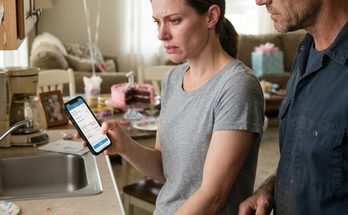
The full video changed the air in Glenale.
Before that, the department still had room to speak in polished phrases.
Misunderstanding.
Procedure.
Pending review.
Officer safety.
After Mrs. Patel’s footage went public, every one of those phrases sounded like an insult.
The video showed Nyla walking home.
It showed the cruiser slowing.
It showed Branson stepping out before any threat existed.
It showed Drummond warning him to slow down.
It showed Mrs. Patel saying the path had always been used by children.
And it showed Nyla’s small voice saying, “I just want to go home.”
That was the part people kept replaying.
Not because it was dramatic.
Because it was clear.
A seven-year-old child had explained the entire situation better than the adults paid to handle it.
By noon, the hashtag had gone local.
By evening, it had gone national.
News vans appeared on Maya’s street. Parents from Nyla’s school sent messages. Veterans groups found out Maya’s background and began showing up quietly at community meetings, not to make noise, but to stand where people could see them.
Pastor Greer hosted the first meeting at the church.
“Stay precise, not loud,” he reminded everyone. “Truth does not need to scream.”
Maya held onto that sentence.
She needed it when patrol cars began circling her block.
She needed it when anonymous posts claimed she was unstable.
She needed it when someone slashed her front tire after the city council meeting.
She needed it most when Sergeant Chu sent Ava a copy of an internal memo.
The memo was signed by Chief Kesler.
New aggressive compliance measures.
Trespass enforcement.
K-9 presence.
Use K-9 to establish compliance.
Focus patrols near the old warehouse path after school hours.
Maya read the line three times.
After school hours.
Not random.
Not misunderstanding.
Policy.
The path children used had been marked as a place to “make examples.”
Ava filed an emergency motion the same day.
That should have been enough to make the department pull back.
Instead, they panicked.
And panic makes people sloppy.
The first sloppy move was the cropped video.
The department leaked footage that showed Maya moving quickly toward Branson, cut tight enough to make her look threatening and degraded enough to hide the edit.
Ava’s tech team had the manipulation identified within hours.
The original video showed Maya moving toward her daughter, not toward the officer.
The second sloppy move was the traffic stop.
Branson pulled Maya over after school, even though he was supposed to be on desk duty. Nyla sat in the back seat with her notebook, drawing a cardinal.
“You failed to signal,” Branson said.
Nyla’s small voice came from the back.
“No, she didn’t. Mommy always signals.”
Maya pressed record on her phone.
Then Sergeant Chu arrived.
“I followed them for six blocks,” Chu said. “Every signal was proper. Your dash camera will confirm that, won’t it?”
Branson’s face tightened.
That stop became another exhibit.
The third sloppy move came at night.
Maya’s new security camera caught an off-duty officer on her porch, staying in the shadows and looking through the side window.
Ava filed for a protection order.
Chu arranged an unmarked watch across the street.
Pastor Greer organized volunteers to keep porch lights on.
Mrs. Patel brought food twice a day and pretended it was just because she had cooked too much.
Nyla started sleeping with her backpack beside the bed.
That broke Maya more than any headline.
Then the department made the mistake that ended them.
At 5:18 one morning, officers pounded on Maya’s door.
“Compliance check.”
Maya was awake instantly.
She had prepared for this.
She hit record on her phone and spoke clearly.
“I am opening the door. I am unarmed. My seven-year-old daughter is in the house.”
The door opened before she reached it.
Four officers came in.
Too fast.
Too coordinated.
Too focused.
They moved through the house like they knew where they wanted to look. Cushions overturned. Drawers opened. Papers scattered.
Maya kept her hands visible.
“I do not consent to this search. I want my attorney present.”
Then Drummond emerged from the living room holding a small evidence bag.
Inside was a single 9mm round.
“Look what we found under your couch cushion,” he said.
Maya looked at it.
Then at him.
“That is planted,” she said. “Check the serial. It will match department inventory.”
For the first time, Drummond flinched.
They arrested Maya anyway.
CPS took Nyla for one hour.
One hour too many.
Ava got it reversed before noon.
Pastor Greer stayed with Nyla until Maya was released.
And the bullet?
It matched a box from the department armory.
That was when Drummond broke.
Not publicly.
Not at first.
He met Sergeant Chu in an office supply closet on the third floor of the station, pale and shaking.
Chu recorded everything.
Drummond admitted Kesler had ordered the missing minute removed from the body camera file.
He admitted the traffic stop was retaliation.
He admitted the bullet had been planted to make Maya look unstable and dangerous.
Then Branson confronted him in the police garage.
Chu anticipated it and was already there, hidden behind a support pillar, phone recording.
Branson’s voice echoed off the concrete.
“You remember what we tell you to remember.”
Drummond said, “She was just a kid.”
Branson snapped.
“For control, you idiot. For showing them who’s in charge. Kesler gets it.”
Then came the sentence that turned the case from misconduct into conspiracy.
“Make it stick. The kid, the mom, both.”
Ava filed the recording the next morning.
The emergency hearing was packed.
Maya wore her old service dress uniform. Not to intimidate anyone. To remind herself who she had been before the town tried to turn her into a headline.
Nyla sat beside her in a blue dress, holding her mother’s hand.
Ava presented the evidence in order.
Mrs. Patel’s doorbell footage.
The county GIS map proving the path was a public utility easement.
The expired K-9 certification.
The seven prior excessive force complaints quietly settled.
The internal memo.
The cropped video analysis.
The armory match on the planted round.
Then the garage recording.
Make it stick.
The kid, the mom, both.
The courtroom went silent.
Drummond stood before his attorney could stop him.
“It’s true,” he said.
His voice shook, but he kept going.
“We were told to make examples. She did nothing wrong. Nyla did nothing wrong.”
Judge Martinez leaned forward.
“Officer Drummond, are you prepared to make that statement under oath?”
“Yes, Your Honor.”
He did.
Twenty minutes.
Names.
Dates.
Orders.
Pressure.
Cover-ups.
By the time he finished, Chief Kesler’s collar was dark with sweat. Branson stared straight ahead, jaw locked, as if still waiting for authority to save him.
It did not.
Judge Martinez referred the full matter to the state attorney general’s office. Branson and Drummond were remanded on evidence tampering and perjury issues pending investigation, with Drummond’s cooperation noted. Kesler surrendered his badge in court.
When the cuffs clicked around Branson’s wrists, Maya did not smile.
Nyla squeezed her hand.
“Did we win, Mommy?”
Maya looked down at her daughter.
“The truth won.”
That was the only answer she wanted Nyla to remember.
The legal case did not end that day.
Real consequences take paperwork.
Depositions.
Settlements.
Consent decrees.
Policy drafts.
Public hearings.
The city eventually settled the civil rights lawsuit with Maya and Nyla. The money mattered, but not as much as the binding consent decree.
Civilian review of all use-of-force incidents.
Mandatory body camera compliance.
Independent investigators.
External K-9 certification.
Quarterly public hearings.
A complete ban on K-9 deployment against minors.
Thor, the dog, was retired to a sanctuary in the Blue Ridge mountains.
Maya asked for that herself.
“He was misused,” she told Ava. “Not evil.”
Ava nodded.
“You still have more grace than most people.”
“No,” Maya said. “I just know the difference between a tool and the hand holding it.”
Part of the settlement funded the Nyla Center, an after-school program and safe-walk initiative for children in Glenale.
The old shortcut was rebuilt.
Solar lights.
Benches.
Emergency call boxes.
Clear signage.
Cherry trees along the path.
At the opening ceremony, Councilwoman Ruth Hail handed Nyla a pair of bright ribbon-cutting scissors painted by local schoolchildren.
The new sign read:
Nyla’s Pathway
Walk Home Safe
Nyla looked up at Maya.
“Do I cut it?”
“You earned it,” Maya said.
The crowd counted down.
Three.
Two.
One.
The ribbon fell.
Children ran onto the path with backpacks bouncing, their parents following slower, some crying openly.
Mrs. Patel stood beside Maya with lemon cookies and a proud little smile.
“She is herself again,” Mrs. Patel said, watching Nyla skip beneath the new lights.
Maya’s throat tightened.
“That is the real victory.”
Months later, Maya changed jobs.
She left the ER and accepted a position as a trauma counselor at the Veterans Center. She still used her medical training, still used the calm that had carried her through war zones, but now she helped other people name what had happened to them without letting it become their whole identity.
Captain Dana Chu helped rebuild the department from within.
Not perfectly.
No reform is perfect.
But officers started learning de-escalation first. Body cameras stopped being optional in practice. The K-9 program became smaller, stricter, and watched by people outside the badge.
Branson lost his badge and faced criminal consequences.
Kesler resigned before the final state report, but the report named him anyway.
Drummond testified.
People argued about whether he deserved sympathy.
Maya did not spend much energy on that question.
He told the truth when it mattered.
Late, yes.
But truth still matters when it arrives late.
One spring morning, Maya and Nyla walked the new pathway together.
The cherry trees were beginning to bloom.
Mrs. Patel’s doorbell camera blinked from across the street, now recording mostly mail carriers, children, and the occasional squirrel that liked her porch rail.
Nyla wore a yellow dress and a backpack covered in hand-drawn birds.
She stopped near the place where it had happened.
For a moment, Maya held her breath.
Then Nyla pointed upward.
“Mom, listen.”
A cardinal called from one of the trees.
Nyla smiled.
“Mr. Cardinal came back.”
Maya knelt and adjusted the strap of her daughter’s backpack.
“Yes,” she said. “He did.”
“Can I walk this way by myself again someday?”
The question hurt.
It also healed.
“Someday,” Maya said. “When you’re ready. And when I’m ready.”
Nyla nodded like that was fair.
Then she slipped her hand into Maya’s.
“Ready to walk home?”
Maya looked down the path.
Public land.
Safe lights.
Children laughing ahead.
A place that had once been used to frighten her daughter now carried her name.
“Always,” Maya said.
And they walked home slowly, not because they were afraid, but because the path finally belonged to everyone.