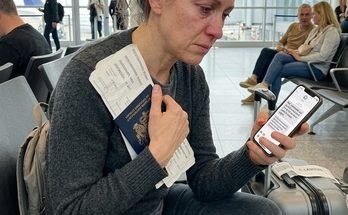
For three days, while Tanya’s family was on a beach in Florida, Aaron’s phone lit up with damage control.
Tanya wrote:
I feel horrible. You know I would never intentionally hurt Norah. It was a miscommunication.
Doug wrote:
Man, it was chaos at the airport. Wires got crossed. No hard feelings.
Carol wrote:
People make mistakes. You need to stop holding on to things.
Aaron did not answer.
He went to work.
Fixed pipes.
Reset breakers.
Picked up Norah.
Made dinner.
Read bedtime stories.
And every night, his daughter woke crying.
“They left me,” she sobbed the first night. “Everyone left me, and I didn’t know where to go.”
He held her until she slept again.
The next day, a vacation commercial came on TV.
A family packing suitcases.
Laughing.
Loading a car.
Norah started crying before Aaron could reach the remote.
“I don’t like suitcases.”
He turned the TV off.
“Okay. No suitcases.”
“Do I have to go somewhere?”
“No, baby.”
“Promise?”
“I promise.”
He made a note in his phone.
Triggered by suitcase commercial. Crying. Asked if she had to leave.
Because that was who Aaron was.
Methodical.
Careful.
A man who kept records because machinery only lied when someone ignored the warning signs.
Carol called on the fourth day.
“You’ve been ignoring everyone. That’s childish.”
“I’ve been taking care of Norah.”
“Well, good. That’s what you should be doing. But this family cannot function if you shut everyone out over one mistake.”
“One mistake.”
“Yes. An unfortunate miscommunication.”
Aaron stood in the hospital boiler room, heat pressing against his face.
“Did anyone ask how Norah is doing?”
“What?”
“You. Tanya. Doug. Kevin. Has anyone asked how she is handling this?”
“Well, I assumed she was fine. Children are resilient.”
“She had nightmares for three nights. She cries when she sees suitcases. She keeps asking if I’m going to leave her.”
Silence.
Then Carol said, smaller, “I’m sure Tanya feels terrible.”
“Her messages don’t sound like someone who feels terrible. They sound like someone annoyed that I’m not making this easier for her.”
“You’re twisting this.”
“No. I’m looking at what happened.”
“We’re family.”
“I’m not the one who forgot that.”
After that, Aaron withdrew.
He muted the group chat.
Declined calls.
Stopped checking social media.
No more Sunday dinners where conversations happened around him.
No more family gatherings where Norah sat in the corner like an extra child.
No more smiling to keep peace with people who had not protected his daughter when it counted.
Tanya kept texting.
I’ve apologized. I don’t know what else you want.
Carol wrote:
Your father would be so disappointed in you.
That one landed.
His father had died when Aaron was nineteen. He had believed in forgiveness, second chances, keeping the peace.
But Aaron knew one thing clearly.
His father would not have left a five-year-old at an airport.
He saved every message.
Not for revenge.
For truth.
Then life became quieter.
At first, Aaron expected loneliness.
Instead, the apartment felt like oxygen.
Norah’s nightmares slowly lessened. She stopped crying at every suitcase. She started talking about butterflies again, about her friends at school, about a book series with a mouse detective.
One evening, while they made pasta, she asked, “Are we happy?”
Aaron looked at her.
“Are we?”
She thought about it.
“I think so. We have fun. We do things together. That’s happy, right?”
“Yeah,” he said. “That’s happy.”
By late spring, consequences began arriving without Aaron needing to push.
Tanya worked at Hillside Credit Union. An internal audit flagged irregularities in her loan approvals. Nothing dramatic at first. Flexible deadlines. Favoritism. Personal relationships not properly disclosed.
Small-town favors, she called them.
Corporate called it risk.
She called Aaron late one night.
“I need your help.”
“With what?”
“Dr. Patterson serves on the credit union board. You work with him at the hospital. You could put in a word.”
“No.”
“Aaron, please. I could lose my job.”
“Then you should have been careful how you did your job.”
“You’re really going to let me lose everything because of one mistake?”
Aaron thought of Norah standing at a gate with no ticket while Tanya chose the plane.
“Interesting how one mistake matters when it’s yours.”
She hung up.
Carol called the next morning.
“If Tanya loses that job, I lose health insurance help. I can’t afford my medications.”
“I’m sorry to hear that.”
“How can you be so cold?”
“I’m not cold. I’m done pretending your problems are my responsibility.”
“Your real family needs you.”
Aaron’s voice went quiet.
“Norah is my real family.”
By June, Tanya was placed on administrative leave. Doug started losing clients when word spread. Carol’s church invitations thinned. No one confronted anyone directly. That was not how small towns worked.
People simply stepped back.
The first public crack came in August at the grocery store.
Aaron and Norah were shopping for school supplies when an older woman with gray hair approached carefully.
“Excuse me,” she said. “Is this the little girl from the airport?”
Aaron’s body went still.
The woman looked at Norah.
“You had a pink suitcase with a broken wheel and a stuffed rabbit. I stayed with you until security came.”
Norah looked up at Aaron.
“I remember her.”
The woman smiled sadly.
“I’m so glad you’re okay.”
After she walked away, Norah tugged Aaron’s sleeve.
“Daddy, why didn’t Aunt Tanya come back that day?”
Aaron knelt in the school supply aisle.
“Sometimes people make bad choices. They don’t think about how their choices hurt other people.”
“Did she forget me?”
“No,” he said softly. “She knew you were there. She chose to get on the plane anyway.”
Norah absorbed that.
“That was mean.”
“Yes.”
“Are we still family?”
Aaron looked at her.
“You and I are family. The rest… I don’t know what they are.”
Norah nodded, then picked up a butterfly folder.
“Can I get this one?”
“Of course.”
That should have been the end of it.
It was not.
The woman told friends.
Friends told friends.
One worked at Carol’s church.
Another knew Doug.
One had a child at Tanya’s school.
Within weeks, people knew.
Not gossip.
Fact.
A credible witness had seen a sobbing child abandoned at the airport.
Tanya noticed when birthday invitations stopped coming. Doug noticed when clients quietly left. Carol noticed when church committees suddenly had “space limitations.”
Then Carol showed up at Aaron’s apartment a week before Thanksgiving.
He opened the door but did not let her in.
“Please,” she said. “I need to talk.”
“Say it from there.”
“I don’t understand why you won’t let this go. We’ve apologized.”
“You said sorry. That is not the same thing.”
“What do you want?”
“I want you to understand what happened.”
“We left her at the airport. I know. It was terrible.”
“You did not just leave her,” Aaron said. “You saw her. You heard there was no ticket. You decided your vacation mattered more than a five-year-old’s safety.”
Carol cried.
“We thought you would come back for her.”
“She thought you would.”
Carol’s face changed.
Aaron continued.
“She told the airport worker her aunt would be right back. She defended you while you were flying to Florida.”
Carol covered her mouth.
“I know it was wrong.”
“No,” Aaron said. “You know people found out. That is different.”
She looked smaller then.
Older.
“What do you want me to say?”
“Nothing.”
“Then what do you want?”
“I want you to leave.”
“Aaron—”
“You don’t lose access to people because they’re angry,” he said. “You lose access because they’re done.”
Then he closed the door.
Norah sat at the kitchen table doing math.
“Was that Grandma?”
“Yes.”
“Is she coming in?”
“No.”
“Okay. Can we have tacos?”
“Sure thing.”
Thanksgiving came and went.
Aaron made a small turkey breast. He and Norah watched movies and ate pumpkin pie. She did not ask about Carol’s house or cousins or family dinner.
She was happy with what was real.
In December, Kevin told Aaron that Tanya had been fired. Doug’s business was struggling. Carol had moved in with Tanya after selling her own house to cover debts.
“Do you feel guilty?” Kevin asked.
“No.”
“Not even a little?”
“They made their choices. Now they’re living with them.”
“And you don’t think you’re being cruel?”
“I think I’m protecting my daughter.”
“From what? They won’t hurt her again.”
“How do you know?”
Kevin had no answer.
In January, Aaron received a job offer from a hospital in Deep Creek, Maryland.
Better pay.
Better benefits.
A fresh start where Norah would not be known as the girl from the airport.
When he told her they were moving, she asked only one question.
“Will it be just us?”
“Just us.”
“Good.”
Packing was easy.
They donated what they did not need.
When Aaron found the pink suitcase with the broken wheel in the back of her closet, he held it up.
“Keep it?”
Norah looked at it for a long moment.
“No. I don’t like it anymore.”
So he threw it away.
They left Asheford in March, exactly one year after the airport.
As the sun rose, they drove past the hospital, the school, the cracked sidewalks, the streets where everyone knew everyone and still somehow did not know how to protect a child.
Halfway to Maryland, Aaron’s phone buzzed.
Carol:
I heard you’re moving. Please call before you leave.
Delete.
Tanya:
Are you really leaving without saying goodbye after everything?
Delete.
Kevin:
We’re still family.
Aaron stared at that one longer.
Then he turned off the phone.
Deep Creek was beautiful.
Their new apartment had a playground and a community pool. Norah’s school had an art teacher and an after-care program. On their first weekend, Aaron rented a small cabin by the lake.
Norah unpacked carefully, set Rabbit on the pillow, and asked, “Are we staying here?”
“For the weekend?”
“No,” she said. “Here. In Maryland.”
Aaron smiled.
“Yeah. This is home now.”
She looked around.
“I like it.”
On Sunday evening, they sat on the porch while the sunset turned the lake orange and pink.
“This is better than Florida would have been,” Norah said.
“Yeah?”
“Because you’re here.”
Aaron pulled her close.
“I’m always here.”
“I know.”
That was the victory.
Not Tanya losing her job.
Not Carol losing her house.
Not Doug losing clients.
Not the family learning that reputation has consequences.
The victory was his daughter saying I know and meaning it.
Later, after Norah fell asleep, Aaron sat alone on the porch and looked at the stars.
His family would tell the story differently.
They would say he changed.
They would say he went cold.
They would say he abandoned them when they needed him.
They would never understand that he had not abandoned anyone.
He had simply stopped accepting their definition of family.
Real family shows up.
Real family stays.
Real family does not ask a child to carry the cost of adult convenience.
Aaron never forgave them.
He did not need to.
Some things are simply over.
Not with shouting.
Not with revenge.
Just over.
Inside, Norah slept without nightmares.
No fear of suitcases.
No airport panic.
No hand reaching out in the dark to make sure he was still there.
Just a child who knew her father would come back.
That was enough.
That was everything.