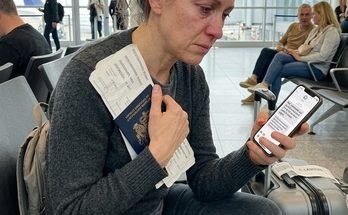
By December, the binder was three inches thick.
Not because I was angry.
Because I was precise.
Anger can be dismissed.
Precision is harder to argue with.
I organized everything by date. The hospital records came first, then the Facebook post, then the comments, then Mark’s reaction, then the school nurse reports, then the changed emergency contact information, then the wellness consultation payments.
Every page had a label.
Every label had a date.
Every date connected to another lie.
I started with the school.
Not as a mother screaming in a front office, but as a parent requesting an administrative review.
I showed them the records.
The emergency contact change.
The nurse notes.
The instruction to minimize calls.
The counselor’s report from the day Emma collapsed.
The woman sitting across from me went very quiet as she read.
She stopped tapping her pen.
Then she said, “Mrs. Thompson, we need to look into this immediately.”
“Yes,” I said. “You do.”
The school opened an internal review within days.
That same week, the insurance company contacted Mark.
I knew because I watched him open the envelope at the kitchen counter.
His face shifted from confusion to anger to something closer to fear.
Your account has been temporarily suspended pending review of irregular claims.
He looked up at me.
I said nothing.
That silence unsettled him more than any accusation could have.
Two days later, another letter arrived.
This one from the district.
They wanted to discuss inconsistencies in Emma’s medical and behavioral records.
That night, Mark shouted until the walls seemed to shake.
He accused the school.
He accused Janet.
He accused me.
“You’re trying to ruin me,” he said.
I looked at him calmly.
“No, Mark. You wrote the story. I just kept the pages.”
That was the first time he had no answer.
The next week, I met with a lawyer.
Her name was Denise Harmon. She was quiet, steady, and did not flinch when I placed the binder on her desk.
She read for almost an hour.
Page after page.
Receipt after receipt.
Report after report.
When she finally closed the binder, she looked at me and said, “This is not just emotional abuse. This is fraud.”
The word landed heavily.
Fraud.
A cleaner word than cruelty.
A word systems understood.
Denise filed the paperwork the following day.
Mark received the subpoena a week later.
By then, Janet Morrison had stopped posting online. Her old comments disappeared. Her account went private. Her friends began calling the post “misunderstood humor,” as if laughter under a child’s hospital crisis could be softened by a new caption.
The hearing was held on a cold gray morning.
I arrived early with the binder in my hands.
Mark came in with his attorney and Janet’s sister, his face set in the tight, controlled expression he used when he wanted the room to believe he was the reasonable one.
Janet did not appear.
She had left town after the insurance audit began.
The hearing did not feel dramatic.
That surprised me.
There was no shouting.
No big speech.
No trembling confession.
Just papers being passed across a table.
False therapy receipts.
Unauthorized school notes.
The changed emergency contact.
The payments.
The timeline of social media posts that matched the so-called consultations.
Mark kept trying to call everything a misunderstanding.
Then Denise placed the forged authorization forms on the table.
I had never seen those forms before the investigator sent them to us.
Each one carried my signature.
Except it was not mine.
The M was too round. The lines too careful. My real signature tilted upward slightly. This one looked practiced.
Mark had been using my name to authorize claims for nearly two years.
Long before Emma’s hospitalization.
Long before the Facebook post.
Long before I understood the shape of the trap.
He had built a paper version of me that agreed with him.
A version of me that called my daughter unstable.
A version of me that gave permission for her pain to become money.
I looked across the table at him.
For the first time, he looked small.
Not sorry.
Small.
At the end of the hearing, the board suspended his insurance privileges and referred the matter for legal review. Janet’s involvement in the false reports triggered professional sanctions and a separate inquiry. The school district opened a formal investigation into how Emma’s medical information had been mishandled.
I did not stay to watch Mark’s reaction.
This was not about watching him fall.
It was about getting Emma out from under the story he had written over her.
When I came home, she was sitting on the porch wrapped in a blanket, sketching the bare winter trees.
She looked up when I reached the steps.
“Is it over?”
“Almost,” I said.
“Did they believe you?”
I sat beside her.
“They believed the documents.”
She looked down at her sketchbook.
“That counts.”
“Yes,” I said. “It does.”
But the story did not stay private.
I sent copies of the binder to an old college friend named Lydia, who had become an investigative journalist. I asked her for advice, not publicity.
She called me the next morning.
“This is not gossip,” she said. “This is a story about systems failing a child because the adults around her controlled the paperwork.”
I hesitated.
Going public meant risk.
Emma’s pain could become spectacle.
People would debate us.
Pick us apart.
Call us dramatic all over again.
Then I remembered that they had already humiliated her publicly. They had already turned drama queen into a family joke. They had already laughed while she was in a hospital bed.
So I told Lydia one thing.
“If you write it, protect Emma’s name.”
She did.
The article came out on a Tuesday.
Mother’s Signature Forged in Family Fraud Case After Teen’s Hospitalization Sparks Review.
No names at first.
No private photos.
No melodrama.
Just facts.
A child mocked online while recovering from collapse.
A father who altered school contact instructions.
Insurance claims based on false wellness reports.
A mother whose signature was forged across years of documentation.
By noon, the article had spread across local news.
By evening, national outlets picked it up.
People recognized the pattern.
Not just the fraud.
The language.
Drama queen.
Attention-seeking.
Overreacting.
Words many people had heard before in their own homes.
Mark came home pale and furious.
“Did you leak this?”
I kept folding towels.
He stood in the kitchen doorway, phone in hand, waiting for the old version of me to explain, apologize, soften, make peace.
I did not.
“You destroyed me,” he said.
I looked at him.
“No. I stopped helping you hide.”
Two days later, I agreed to one televised interview.
No Emma.
No hospital photos.
No tears rehearsed for strangers.
Just me in a gray blouse under bright studio lights, speaking carefully.
The anchor asked, “How did it feel to discover the people closest to you were exploiting your trust?”
I took a breath.
“It did not feel like betrayal,” I said. “It felt like confirmation. I always knew something was wrong. I just did not know how deep it went.”
“And your daughter?”
“She is healing,” I said. “For the first time, she is being believed.”
That clip went viral.
Not because I screamed.
Because I did not.
The calm frightened people more than rage would have.
After that, the consequences came quickly.
Mark lost his position after the investigation became public. The insurance board pursued restitution and penalties. Janet lost her certifications and later accepted sanctions that ended her consulting work. The school district revised its student wellness policies and required dual-parent verification for certain medical-contact changes.
Lucas wrote me a letter.
He was nineteen by then, living in another city, trying to make himself smaller than the family collapse.
His handwriting shook.
I knew things were wrong, he wrote. I saw documents. I heard Dad and Aunt Janet talking. I thought if I stayed quiet, it would go away. I did not protect Emma. I did not protect you.
For the first time in years, I cried.
Not because he deserved instant forgiveness.
Because someone else finally said the quiet part out loud.
I wrote back.
Start with honesty. That is where rebuilding begins.
Months later, the final notice arrived from the insurance board.
Case closed.
Full restitution.
Suspended privileges.
Permanent ban from handling similar claims.
I read those two words again and again.
Case closed.
It sounded too clean for what had happened.
No mention of Emma’s trembling hands.
No mention of the hospital hallway.
No mention of the Facebook post that began the end of our old life.
But it was enough.
That night, Emma and I sat on the porch as the sun lowered behind the neighborhood.
For the first time in a long time, she leaned against me.
“Do you think people can really change?” she asked.
I thought about Lucas.
Mark.
Janet.
Myself.
“Yes,” I said. “But not everyone does.”
She nodded.
“Then maybe we just change enough for ourselves.”
That became the beginning of our new life.
Emma started drawing again.
At first, small sketches in the margins of school notebooks. Then full pages. Women holding broken compasses. Children made of glass. Mothers standing under storms without bending.
One of her drawings went quietly viral online.
A faceless girl with the words drama queen painted behind her in gold.
Someone commented, I was called that too.
Then another.
And another.
A year later, I started a nonprofit at our old dining table.
The Second Voice Foundation.
Its mission was simple: help people document the truth when the people around them are trying to rewrite it.
We taught survivors how to keep records, protect digital files, understand consent forms, preserve evidence, and ask for help before silence became a cage.
Emma designed the logo.
A pen breaking through a chain.
“Stories should not be prisons,” she said.
By the second year, we had lawyers volunteering pro bono time, therapists offering sessions, and schools requesting training. Emma gave her first public art talk at a small gallery event titled Drama Queen.
She stood at the microphone in a black dress, hands steady.
“They called me dramatic,” she said. “But all I ever did was react to what was real.”
The room went silent.
Then people stood.
I watched from the back, my hand over my mouth, not because she sounded healed.
Because she sounded true.
Ten years later, the Second Voice Foundation had offices in five cities and partner programs overseas. Emma was no longer the girl in the hospital bed. She was a director, an artist, and a woman who carried her sensitivity like a language.
At our tenth anniversary event, she unveiled a mural in the main hall.
A faceless woman standing in a storm.
Around her were all the words people had used to dismiss us.
Crazy.
Liar.
Overdramatic.
Drama queen.
But every word was painted in gold.
Underneath, Emma had written:
Everything they took, we turned to strength.
That night, I stood on stage without notes.
“Ten years ago,” I said, “my daughter was mocked for feeling too deeply. I was called overprotective. We were dismissed, disbelieved, and labeled dramatic. But drama, I have learned, is just the soul refusing to go silent.”
The room was still.
“Let them call us dramatic,” I said. “Only people who feel deeply ever build anything that lasts.”
After the applause ended and the hall emptied, I walked past Emma’s mural one last time.
I thought of the hospital.
The monitor.
The Facebook post.
Mark’s like under Janet’s cruelty.
The binder.
The forged signature.
The first time Emma said, They believe us.
So much had been stolen.
But not the ending.
We had written that ourselves.
And as I locked the doors behind me and looked out across the city lights, I understood what victory really was.
Not revenge.
Not applause.
Not watching them lose everything.
Victory was this:
They tried to make my daughter a punchline.
She became a voice.
They tried to make me doubt my reality.
I built a foundation from proof.
They called us dramatic because they thought it would make us smaller.
Instead, it taught us how loud truth can become when it finally has a second voice.