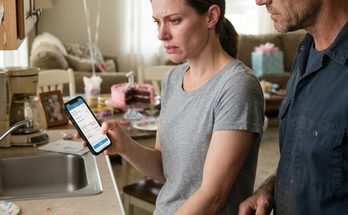
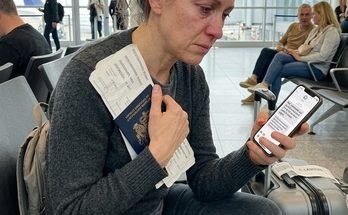
The hospital waiting room felt colder than it should have.
Marina sat beside me in her pale blue engagement dress, the same dress she had been wearing when the day still had a future.
Neither of us said much.
There were too many sounds around us.
Nurses moving through automatic doors.
Phones ringing.
Someone crying softly behind a curtain.
My own phone buzzing again and again with messages from people at the party.
Is Sophia okay?
We saw everything.
Please tell us what you need.
I answered the same way every time.
At the hospital. Will update when we know more.
Marina stared at the double doors.
“The livestream,” she said finally. “Cynthia saw everything.”
“Good.”
She turned toward me.
“Good?”
“If it hadn’t been recorded, Jessa would already be saying it was an accident. She would say Sophia fell. She would say people misunderstood.”
Marina looked down at her hands.
“She’s still my sister.”
“She hurt my daughter.”
The sentence sat between us.
Hard.
Clean.
Necessary.
For the first time since I had known her, Marina did not defend Jessa.
She did not say Jessa was drunk.
She did not say Jessa was insecure.
She did not say Jessa had a bad childhood, a hard week, wedding stress, or too much pressure.
She just whispered, “I should have stopped this years ago.”
I did not absolve her.
Not then.
Not because I wanted to punish her, but because Marina needed to feel the weight of the truth long enough to stop carrying lies for other people.
“My parents always protected her,” she said. “Jessa was the baby. I was the responsible one. So I handled things. I apologized for her. I convinced people to forgive her. I convinced you.”
I looked at her.
“You said no today.”
“Too late.”
“Not for everything that comes next.”
That was the first real line between Marina’s old family and the one we were building.
The doctor came out forty minutes later.
Nothing broken.
But Sophia’s knee had partially dislocated on impact, then shifted back into place. The surrounding tissue was damaged. Her inflammation was severe. The injury would set her back weeks, maybe months.
No surgery for now.
Brace.
Medication.
Monitoring.
Physical therapy.
Six to eight weeks before she could return to baseline, assuming no complications.
Baseline.
The word sounded harmless until you have a child whose baseline already includes pain.
In Room 7, Sophia looked tiny in the hospital bed. Her leg was braced and propped on pillows. Someone had given her a stuffed bear in a little doctor coat.
“Daddy,” she said when I came in.
I was at her side in two steps.
“Hey, baby.”
“My knee hurts. But the medicine makes everything fuzzy.”
“That’s okay. Let the medicine help.”
She looked from me to Marina.
“Did Miss Jessa mean to hurt me?”
Marina made a small sound beside me.
I sat carefully on the edge of the bed.
“I think Jessa was angry and made a very bad choice,” I said. “Whether she meant to hurt you or didn’t care enough to think about it, she did hurt you. That part matters.”
Sophia’s fingers worked at the bear’s coat.
“I don’t want to see her again.”
“You don’t have to.”
Marina moved closer, tears running freely now.
“I’m so sorry, Sophia. I should have protected you from her.”
Sophia looked up at her.
“You didn’t push me. She did.”
Marina covered her mouth.
“My teacher says we’re responsible for our own choices,” Sophia added. “You chose to be nice to me. She chose to be mean. Those are different choices.”
My seven-year-old daughter had just said what half the adults in Marina’s family had spent decades avoiding.
Marina took Sophia’s hand.
“You’re right. And I’m choosing now to make sure she never gets to hurt you again.”
The police came that night.
Officer Torres took our statements. Marina gave hers without hesitation. The livestream had already been sent to police. The EMTs had documented the injury. The hospital filed its required report. Child Protective Services confirmed Sophia was safe at home and that the danger had come from a third party.
Then Marina’s mother called.
I could hear the raised voice through the phone.
Marina listened for a moment.
Then her spine straightened.
“No,” she said. “You listen to me. Jessa pulled a disabled child out of a wheelchair and dropped her on concrete. Sophia is in the hospital. The police arrested Jessa. She deserves the charges.”
There was a pause.
“She didn’t mean to?” Marina repeated, voice shaking. “I don’t care what she meant. I care what she did.”
Another pause.
Then, quieter.
“If you make me choose between protecting Jessa and protecting Sophia, I choose Sophia. Every single time.”
She hung up with trembling hands.
I held her while she cried in the hallway.
Not because she regretted choosing Sophia.
Because choosing correctly had cost her something.
Three weeks later, we sat in a Maple Glenn courtroom for Jessa’s arraignment.
Sophia stayed home with Mrs. Patterson, safe on the couch with her braced leg propped on pillows and a bowl of macaroni and cheese within reach.
The courtroom was fuller than I expected.
Marina’s cousin came.
A few parents from Sophia’s school.
Some neighbors.
People who had watched the livestream or heard enough about it to understand that silence would be another kind of permission.
Marina’s parents sat near the front on the other side.
Her mother would not look at us.
Jessa was brought in wearing an orange jumpsuit that swallowed her frame. Her hair hung limp around her face. She looked smaller than she had at the pavilion, but not softer.
When the judge read the charges, she pleaded not guilty.
Of course she did.
Judge Patricia Hendricks reviewed the file, the video evidence, the medical report, and the witness statements.
Then she set bail at $50,000.
Mrs. Rowan gasped.
The judge did not pause.
No contact with Sophia or our household.
GPS monitor.
Fifty-mile travel restriction.
Any violation and bail would be revoked.
When Jessa looked back at Marina, her face crumpled.
Marina did not look away.
That mattered.
Two weeks later, Marina and I got married at the Lakeside Gazebo.
No big reception.
No family livestream.
No Jessa.
No Rowan parents.
Just two dozen people who had shown us what side they stood on when standing up mattered.
Sophia wore a soft blue dress and silver shoes. Her wheelchair had new stickers: stars, planets, and tiny cartoon cats.
When the officiant asked if anyone objected, Sophia whispered, “They better not.”
The whole front row tried not to laugh.
After the ceremony, Marina knelt in front of Sophia.
“Can I be officially your family now?”
Sophia thought about it with complete seriousness.
“Only if you share stickers.”
Marina cried harder than she had during the vows.
The trial came in February.
By then, Sophia was stronger, though still not fully back to where she had been. Physical therapy helped. Medication helped. Routine helped.
But she had nightmares sometimes.
I would find her awake at midnight, clutching the stuffed doctor bear, asking if her wheelchair was locked.
That is what people forget when they talk about “mistakes.”
The person who made the mistake moves on.
The child checks wheels in the dark.
The prosecutor, Katherine Wells, opened the trial with the video.
No dramatic introduction.
No theatrical outrage.
Just the footage.
The party.
Sophia smiling.
Jessa’s voice cutting through the room.
The grab.
The pull.
The fall.
The scream.
Two jurors flinched.
That was the case before a single witness spoke.
Witnesses confirmed the drinking, the comments, the jealousy, the moment Jessa crossed the line. The EMT testified about Sophia’s distress. The doctor explained the injury. Sophia’s physical therapist described the setback.
I testified.
The defense tried to frame me as an angry father who refused reconciliation.
I answered with facts.
My daughter had a documented medical condition.
Jessa had no training.
No permission.
No reason to touch her chair.
The fall caused documented injury.
Marina testified after me.
That was the hardest part for her.
Her parents sat behind Jessa.
Her sister sat at the defense table.
And Marina still told the truth.
“I love my sister,” she said. “But what she did was unforgivable. She hurt a child deliberately, and I will not pretend otherwise just because we are related.”
Her mother made a sound from the gallery.
Marina did not turn around.
Then Jessa testified.
Conservative dress.
Minimal makeup.
Soft voice.
She cried through the story her lawyer wanted the jury to hear.
She was stressed.
She felt ignored.
She had too much to drink.
She thought Sophia did not really need the chair.
She did not mean to hurt anyone.
Then Wells stood for cross-examination.
“Had anyone ever asked you to assist Sophia with mobility?”
“No.”
“Had you ever been trained to help a child with her condition?”
“No.”
“Were you drinking?”
“A few drinks.”
“You were upset that attention was being given to a seven-year-old disabled child, and without training, without permission, and while under the influence of alcohol, you pulled that child from her wheelchair and released her over concrete. Is that accurate?”
“That’s not how—”
Wells played the video again.
The courtroom watched in silence.
When the screen froze on Sophia crying on the ground, Jessa had no words left that could survive it.
The jury deliberated for three hours.
Guilty on all counts.
Child endangerment.
Assault on a minor.
Reckless conduct resulting in bodily harm.
Jessa cried when they took her back into custody.
I felt no joy.
Only relief.
At sentencing, the judge read Sophia’s letter aloud.
I don’t hate Miss Jessa, but I am scared of her. I think she should go somewhere where she can learn to be nicer. Maybe then she won’t hurt other kids who need wheelchairs.
The courtroom was silent after that.
Judge Hendricks sentenced Jessa to six months in county jail, two years of probation, mandatory anger management, substance abuse counseling, two hundred hours of community service at a disability support center, and a five-year restraining order protecting Sophia and our household.
“Apologies are meaningless without changed behavior,” the judge told her. “Prove remorse with actions.”
Three months later, a letter arrived from the county jail.
Jessa apologized.
No excuses.
No request for forgiveness.
Just acknowledgment.
Marina kept the letter but did not answer it.
Sophia asked if Jessa had said sorry.
“Yes,” I told her.
She considered that.
“That’s good. But I still don’t want to see her.”
“You don’t have to.”
She nodded and went back to coloring Saturn’s rings.
That afternoon, we took Sophia to the park.
Not the pavilion.
The playground on the other side.
She was walking more by then, using the wheelchair for longer distances and painful days. She climbed onto the swing slowly, carefully, then leaned back as Marina pushed her.
Her laugh rose into the spring air.
Marina stood beside me and took my hand.
We watched Sophia swing higher, hair flying, face lifted toward the sky like a child who had remembered what it felt like to trust the ground beneath her.
Justice did not erase the pain.
Consequences did not undo the fall.
But accountability opened space for healing.
And for our family, imperfect, chosen, and finally honest, that space was enough.