“Is that what you promised her?”
Riley nodded.
“I promised I wouldn’t let you forget what she always told you.”
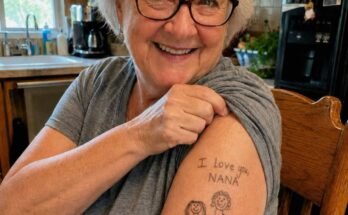
My eyes went back to her arm.
I looked at her tattoo.
“When it gets too heavy, give me some.”
Suddenly the $340 didn’t look like proof my daughter thought only about herself.
It looked like grief.
Permanent, impulsive, 16-year-old grief.
That didn’t make everything okay.
“You still shouldn’t have done this without telling us.”
“I know.”
“And whoever tattooed a 16-year-old without our permission is something we’re going to discuss.”
“I know.”
“And spending every dollar you had—”
“I know, Mom.”
“Three hundred and forty dollars, Riley.”
She rubbed her thumb beside the tattoo.
“Grandma gave me the first 20.”
I stopped.
“For my 14th birthday. She told me to save it for something I’d still care about years later.”
“I don’t think she meant this.”
“Probably not.”
For the first time that night, Riley almost smiled.
“But I’m pretty sure I’ll still care.”
“But I understand why.”
She finally looked at me.
“And you’re going to tell us where you got it.”
Riley’s eyes dropped.
“I forged your signature.”
I stared at her.
“What?”
“The shop wanted a consent form. I signed your name.”
Tom closed his eyes.
“Riley.”
“I know.”
For the first time, she sounded 16 again instead of impossibly composed.
“I know it was stupid.”
“It was.”
She nodded.
“Understanding the tattoo doesn’t erase what you did to get it.”
“I know.”
I swallowed.
“And what I said yesterday was cruel.”
Riley looked down.
“I asked whether you ever thought about anyone but yourself.”
“Te dzieci nie są twoje! powiedział do mnie starszy nieznajomy, wskazując na moje dzieci na placu zabaw.
Na weselu mojej córki widziałem jej narzeczonego i druhnę wymykających się do łazienki – to, czego byłem świadkiem, przyprawiło mnie o dreszcze
W wieku 55 lat zakochałam się w mężczyźnie o połowę ode mnie starszym – było pięknie, dopóki nie usłyszałam, jak rozmawia z moją siostrą
Silence.
“I was wrong.”
Her eyes filled.
“That one hurt.”
“I know.”
She didn’t tell me it was okay.
I’m glad she didn’t.
I had hurt her.
Understanding why didn’t erase it.
So I apologized again.
And this time, I didn’t ask her to make me feel better about it.
Understanding Riley didn’t mean pretending she’d done nothing wrong.
The next morning, we contacted the shop. They’d accepted a forged consent form without ever speaking to me, and Tom filed a complaint.
Riley’s consequences were a month without her phone, and a summer spent rebuilding the savings she’d emptied.
She complained about both.
Which, strangely, made me feel better.
She was grieving.
She was also still 16.
That evening, I took the funeral invoice off the refrigerator.
Riley saw me.
“How much did you say?”
“Don’t worry about it.”
She raised an eyebrow.
I heard my own words.
Then I heard my mother’s.
I sighed.
“Okay. That’s exactly the problem, isn’t it?”
Riley almost smiled.
I put the invoice on the table.
“We still owe $2,180. We can pay it. It’s just going to take a little while.”
“Okay.”
“You don’t need to fix it.”
“I know.”
“But I also don’t need to pretend everything’s fine.”
She nodded.
That became our new rule.
Riley was still 16.
I was still her mother.
She didn’t become my therapist, accountant, or replacement for Grandma.
But I stopped treating her like she was either a problem to manage or a child too fragile to know when life was hard.
And Riley stopped pretending nothing hurt.
A few weeks later, I dropped a jar of pasta sauce.
Glass shattered.
Max screamed.
Tom called from upstairs asking what happened.
The phone started ringing.
And suddenly I was standing in the middle of red sauce and broken glass with tears running down my face.
“I’m fine,” I said automatically.
Riley appeared in the doorway.
She looked at me.
Then at her arm.
The tattoo had healed.
She tapped the words once.
“Too heavy?”
I almost said no.
That was what my mother would’ve said.
Apparently, it was what I’d taught Riley to say too.
I looked at my daughter.
“Yeah.”
Riley pulled out a kitchen chair.
“Then give me some.”
I sat down.
She didn’t solve anything.
She didn’t need to.
Tom cleaned the glass.
Riley distracted Max.
And I sat there for five whole minutes and let myself miss my mother.
I’d spent 16 years believing being Riley’s mother meant carrying the heavy things so she wouldn’t have to.
My mother had apparently believed the same thing about me.
We’d both been wrong.
I still didn’t approve of my 16-year-old secretly getting a tattoo.
But every time I looked at it, I remembered the lesson I’d nearly missed because I was too busy being angry about how she’d written it down.
Loving someone doesn’t mean carrying everything for them.
Sometimes it means trusting them enough to say it’s heavy.
Riley tapped her arm.
“Better?”
I nodded.
“Better.”
And for once, instead of picking everything back up myself, I left some of it on the table.