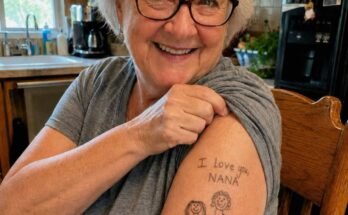
Underneath the words was a tiny crooked sun.
Seven uneven rays.
Two enormous eyes.
A sideways smile.
“That’s mine!”
I looked at him.
“What?”
“I drawed that!”
Riley smiled for the first time in three days.
“You did.”
“Why is Max’s sun on Grandma’s writing?” I asked.
Riley touched the little sun.
“He drew it for her the last week she could still come downstairs. Grandma taped it beside her bed.”
Max’s eyes widened.
“She liked it?”
Riley’s face softened.
“She said it was the happiest sun she’d ever seen.”
“Then why put it on your arm?”
Riley looked at the words above it.
“Because I wanted something from everyone I was trying to remember this for.”
“What do you mean?”
Riley went upstairs.
Tom started after her.
“Sit down,” I said.
She returned carrying a battered blue cookie tin.
I’d seen it at Mom’s house.
Riley placed it on the coffee table.
Inside were dozens of folded pieces of paper.
A failed math test from eighth grade.
A friendship bracelet.
A folded note with “I HATE MOM” written across the front.
I recognized it.
That had been the night Riley disappeared to Mom’s after I screamed at her for lying about a school assignment.
She’d come home the next morning calm and apologetic.
I’d congratulated myself for handling it well.
Apparently, Mom had handled the part I never saw.
Beneath it was a photograph of Riley and Mom making pancakes.
And Max’s crooked sun.
“What is this?”
“Grandma’s box.”
“For what?”
“For stuff I couldn’t carry.”
I stared at her.
Riley picked up the failed test.
“When I thought you’d be disappointed, I went to Grandma’s. She made me tell you eventually. But first she’d put whatever I was scared about in here.”
Another note.
“When Mia stopped talking to me.”
Another.
“When I thought everybody at school hated me.”
I looked through years of my daughter’s life.
Pain I’d never known existed.
“I thought you went to Grandma’s because she let you eat junk food.”
“She did that too.”
My eyes burned.
“Why didn’t she tell me?”
“Because sometimes I needed someone who wasn’t my mom.”
That hurt.
But not because Riley had done anything wrong.
Because suddenly I understood how much I’d mistaken silence for ease.
Then I saw something else in the box.
A pharmacy receipt.
Dated three months earlier.
Mom’s medication.
Riley’s name was handwritten across the top.
“What’s this?”
She went quiet.
“Riley?”
“I picked it up.”
“Why?”
“Grandma wasn’t feeling good.”
I looked at Tom.
“How often?”
Riley shrugged.
“Sometimes.”
“How often?”
“Most days after school near the end.”
The room seemed to tilt.
I knew Mom had been getting weaker.
I’d taken her to appointments, filled her freezer, and called every night.
What I hadn’t known was what happened between those phone calls.
Riley had brought groceries, changed Mom’s sheets, made soup, and sat with her during the afternoons when she was too weak to get downstairs. Once, she had even washed her hair over the kitchen sink because Grandma was embarrassed to ask me for help.
“Why didn’t anyone tell me?”
“Grandma didn’t want you to know.”
“Why?”
Riley gave a small, sad laugh.
“Because you already had too much.”
The sentence hit me harder than anger could have.
My mother had been protecting me.
Riley had been protecting me.
And I’d called her selfish.
“But the funeral,” I whispered. “You didn’t even cry.”
Riley stared at me.
Then she said quietly, “I already cried with her.”
“What?”
“The night she told me she wasn’t getting better.”
I couldn’t move.
“She told you?”
Riley nodded.
“She was scared.”
“Scared of dying?”
Riley shook her head.
“Scared of leaving you.”
Somehow, that hurt worse.
Riley had seen a fear my mother had never shown me.
“She cried. Then I cried. We sat on her bed for like two hours.”
Riley’s voice cracked.
It was the first time I’d heard it crack since Mom died.
“After she died, everybody kept waiting for me to cry again. I couldn’t.”
Tom looked down.
“I said you didn’t care,” he whispered.
Riley looked at him.
“I heard you.”
His face fell.
“I’m sorry.”
I sat beside her.
“Is that when she wrote this?”
I touched the air above Riley’s tattoo.
“No.”
Riley pulled a folded piece of paper from the bottom of the tin.
“She wrote this for me that night.”
Mom’s handwriting covered half the page.
At the top was the sentence now inked into Riley’s arm.
Underneath it was something else.
“Your mother will try to carry all of us when I’m gone. Don’t let her.”
I covered my mouth.
“She was talking about me?”
“Mostly.”
“Why didn’t you show me?”
“Would you have listened?”
I wanted to say yes.
Then I looked toward the kitchen.
The unpaid funeral bill.
Tom’s reduced hours.
Max.
Laundry.
Groceries.
Phone calls I’d refused to return because I didn’t have time to fall apart.
Probably not.
“I asked her what I was supposed to do,” Riley said. “She told me I couldn’t fix your grief. Just remind you that you didn’t have to carry it alone.”