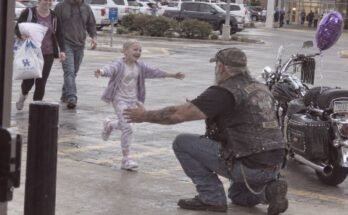
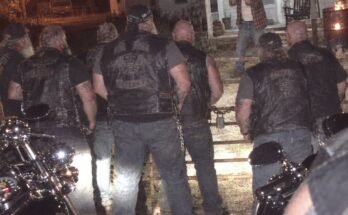
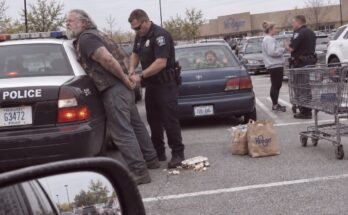
Our club rode into a hostage call before cops did and now we’re being arrested.
Eleven of us bikers, every one of us over sixty, were on a charity ride through Pike County when it happened. Before that day was over, I was sitting in the back of a state trooper’s car with my wrists zip-tied behind me, and I want you to know how we got there.
About four in the afternoon, a woman came running barefoot out of a cornfield onto Route 9. She was waving both arms and bleeding from her lip.
We pulled over in the gravel. She grabbed the front of my vest and could barely get the words out.
“He’s got my girls,” she said. “He’s got a shotgun and he says he’ll do it this time.”
Her daughters were 6 and 9. They were still inside the farmhouse at the end of that dirt road.
Our road captain, Dale, called 911. The dispatcher told him the nearest deputy was 38 minutes out and to stay back and wait.
Thirty-eight minutes. We could hear a little girl screaming all the way from the road.
Our president, Big Earl, was 68 with a bad heart and a steel plate in his hip. He was already walking up that dirt road before any of us could stop him.
He told us to stay put. He said he knew how to talk to angry men because he used to be one.
Nobody stayed put. Ten old bikers followed him up that road on foot.
When we reached the porch, the screen door was hanging open. A man stood in the kitchen with a shotgun pointed at two little girls huddled under the table.
Earl stopped dead in the doorway. I’d ridden with him for 26 years and had never once seen his hands shake.
They were shaking now.
He took one step into that kitchen and said the man’s name like he’d said it a thousand times before.
“Danny,” he said, and his voice cracked. “Danny, put it down. It’s me. It’s your dad.”
Earl Whitlock had been our president longer than some of us had been riding. I’d followed him through a snowstorm in Wyoming and stood next to him at nine funerals, and I would have sworn on my life the man didn’t have a single living relative.
The man in the kitchen swung the shotgun away from the table and pointed it straight at Earl’s chest.
“You don’t get to be here,” he said. “You don’t get to walk in my house.”
He was close to forty, thick through the shoulders like Earl, with the same heavy brow. I could smell the whiskey on him from the doorway. An empty bottle sat on the counter next to a pink lunchbox and a layoff notice from the paper mill.
Earl didn’t back up. He raised both hands where Danny could see them, and the faded eagle tattoo on his right forearm stretched as he did it.
“You’re right,” Earl said. “I don’t. But I’m here, son, and I’m not leaving till you put that down.”
Behind me on the porch, I could hear Dale breathing hard and somebody whispering the Lord’s Prayer. The little one under the table had gone quiet, and that scared me worse than the screaming had.
“How?” Danny said, and his voice broke right in the middle of the word. “How are you even standing in my kitchen?”
“I’ll tell you after,” Earl said. “Put it down first.”
“Thirty years, and you show up today? Today?”
“I know.”
“You don’t know nothing!” Danny jabbed the barrel toward him. “You don’t know what it was like!”
Earl started lowering himself to the floor. With that steel plate in his hip, I’d watched him take two full minutes just to climb off his bike at a rest stop. He got down on one knee on that linoleum anyway, right between the shotgun and the table where those two little girls were hiding.
“I know exactly what it was like,” Earl said quietly. “You were eight. You were under a table just like that one.”
Danny’s face changed.
Then Earl told the story, right there in front of all of us. I’d never heard a word of it. I don’t think anybody alive had.
Thirty years ago, Earl came home from the bar on a Friday night and found his wife packing a suitcase. He took his deer rifle down off the rack in the kitchen and said things to her no man should ever say. He never fired it. But a little boy hid under the kitchen table with his hands over his ears, watching his daddy’s work boots go back and forth across the floor for most of an hour.
“Your mama took you to your grandma’s the next morning,” Earl said. “I never lived under a roof with you again. I got sober two years later, and by then you wouldn’t even come to the phone. I don’t blame you. I’d have hung up on me too.”
The shotgun was shaking now.
“You remember what it felt like under there,” Earl said. “Your girls are going to remember this for the rest of their lives, Danny. Every second of it. Unless you stop right now. Then maybe the part they remember is the part where their daddy stopped.”
Danny’s mouth opened, but nothing came out.
“You did this to me,” he finally whispered.
“I did,” Earl said. “So if you need to point that thing at somebody, point it at me. I earned it. They didn’t.”
Danny took one step forward and pressed the end of the barrel flat against Earl’s chest, right over the patch on his vest.
I spent thirty-one years climbing power poles, a lot of them in ice storms with seven thousand volts humming a foot from my ear. I have never been as scared as I was watching that barrel touch Earl’s vest.
Then a small voice came from under the table.
“Daddy?”
The older girl had crawled halfway out. She had a scraped knee and red hair like her mother, and she was staring straight at Earl.
“Daddy, that’s the man from your truck,” she said. “The picture in the visor. He’s got the same bird on his arm.”