Part 1: I Saved a Dying Woman on the Sidewalk. Then My Mother’s Boss Threatened to Fire Her.
My name is Julian Parker. I was ten years old when I learned that doing the right thing could still land someone you love in serious trouble.
It happened on a Tuesday afternoon in Columbus, Ohio.
My mother, Marissa Parker, cleaned offices for a small marketing firm called Morgan Creative Solutions. She’d worked there almost three years, usually staying until six before heading off to her second job at a neighborhood café. We couldn’t afford after-school childcare, so I often waited for her at the agency.
I wasn’t an employee. I was just a kid who did his homework in the break room and sometimes pitched in with small chores, like setting out chairs, sorting brochures, or carrying supplies. At first the staff thought it was sweet. Then Caleb Morgan, the agency’s owner, began to expect it.
“Julian, take these folders upstairs.”
“Julian, make sure the conference room is ready.”
“Julian, don’t just sit there. Make yourself useful.”
Mom hated it when he ordered me around, but she was afraid to complain. Caleb controlled her schedule, and losing that job would mean losing most of our rent money.
That Tuesday, Caleb was getting ready for the biggest client presentation of the year. Before I left school, Mom called.
“Sweetheart, Mr. Morgan needs those printed materials from the copy shop. They’re already paid for. Can you pick them up on your way?”
“Sure, Mom.”
“Come straight to the office afterward. And don’t rush across the streets.”
I promised.
The copy shop was only a few blocks from the agency. I collected the package and started walking, holding it carefully against my chest. That’s when I saw the woman collapse.
She was standing near a bus stop in a pale blue coat, carrying a brown leather handbag. One moment she was reaching for the bench. The next she was on the pavement, struggling to breathe. People turned their heads. A few slowed down. Nobody seemed to know what to do.
I dropped the package beside the bench and ran to her.
“Ma’am? Can you hear me?”
Her eyes opened slightly. She tried to speak, but no words came out. I pulled my phone from my backpack and called 911. The dispatcher asked where I was and whether the woman was breathing.
“Yes, but something’s wrong,” I said, my voice shaking. “She’s trying really hard.”
“Stay with her. Help is on the way.”
I followed the instructions as best I could. I didn’t try to move her. I told her an ambulance was coming and kept talking so she’d know she wasn’t alone.
“Please hold on,” I whispered. “They’re coming.”
When the paramedics arrived, one asked who had called.
“I did.”
He looked surprised. “How old are you?”
“Ten.”
“You did the right thing, buddy.”
I watched them lift her onto a stretcher. Before the ambulance doors closed, she reached weakly toward me.
“Thank you,” she whispered.
I nodded, unable to speak. Then I remembered the package. And Caleb Morgan.
I was almost forty minutes late. By the time I reached the agency, the presentation was over. Several employees stood near the reception desk talking in low voices. Caleb waited beside the conference room, and the moment he saw me his expression hardened.
“Where have you been?”
I stopped. “I’m sorry, sir. A woman collapsed on the sidewalk, and I had to call an ambulance.”
He stared at me. “Where are the materials?”
I held out the package. “Right here.”
He snatched it from my hands. “Do you have any idea what you’ve done?”
I shook my head.
“We just lost a major account!”
My stomach tightened. “I’m sorry. I came as fast as I could.”
He stepped closer. “Was that woman your mother?”
“No, sir.”
“Your grandmother?”
“No.”
“Then why did you think she was your responsibility?”
I looked at him, confused. “Because she couldn’t breathe.”
He gave a bitter laugh. “You should have kept walking.”
The words hit harder than his shouting.
My mother appeared from the hallway, still in her gray cleaning apron. “Mr. Morgan, please. He’s only ten.”
Caleb turned on her. “And you’re responsible for him.”
Mom moved beside me. “He stopped to help someone who needed an ambulance.”
“I don’t care why he stopped. I needed those materials before the meeting.”
“He’s a child,” Mom said quietly. “He doesn’t work for you.”
Caleb’s face darkened. “Then perhaps you should find somewhere else to bring him after school.”
Mom went still. “Sir?”
“Consider this your final warning, Marissa. If your son causes another problem, I’ll find someone who can do your job without dragging distractions into my office.”
I felt Mom’s hand tighten around mine.
“Please,” I whispered. “Don’t fire her. It was my fault.”
Caleb looked down at me. “Then maybe you’ll learn that helping strangers doesn’t pay the bills.”
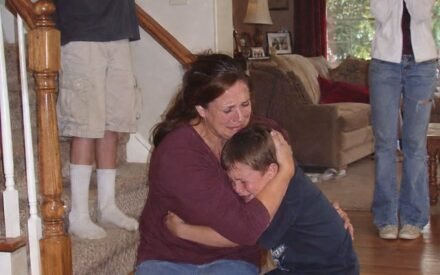
Nobody spoke. Mom picked up my backpack and steered me toward the door. Outside, I finally started to cry.
“I’m sorry, Mom.”
She knelt in front of me. “Julian, look at me.” I tried. “You did nothing wrong.”
“But he might fire you.”
“That would be his decision, not your fault.”
I wanted to believe her. But I knew how much we needed her paycheck.
That night Mom barely touched her dinner. She sat at our kitchen table going over bills and calculating how long we could last if Caleb cut her hours. I lay awake thinking about the woman. I wondered whether she’d survived. I wondered whether Caleb was right about helping strangers. And I wondered why being kind had made my mother so afraid.
What I didn’t know was that the woman from the sidewalk had already begun looking for me. And when she found out what Caleb Morgan had said, she decided to visit his office herself.
Part 2: The Woman I Saved Returned to My Mother’s Workplace, and My Boss’s Secret Began to Unravel
The next afternoon, Mom got a phone call while I was still at school. It was Caleb Morgan. He wanted her at the agency right away, and he told her to bring me.
She sounded worried when she picked me up.
“Did something happen?” I asked.
“I don’t know, sweetheart.”
“Is he going to fire you?”
She didn’t answer right away. “Whatever happens, I want you to remember that you did the right thing yesterday.”
At the agency the receptionist looked unusually nervous. “Mr. Morgan is waiting in the conference room.”
Mom took my hand, and we walked down the hallway together. Caleb stood beside the long conference table, his face pale. Across from him sat a woman in a light blue coat. I recognized her immediately.
“You’re okay!”
She turned to me, and her face softened. “Thanks to you, young man.”
I smiled before remembering where we were. The woman stood carefully.
“My name is Eleanor Whitaker. I’ve been hoping to meet you again.”
Mom stopped. “Whitaker?”
Eleanor glanced at her. “Yes. Have we met?”
“I don’t think so,” Mom said. But something in her expression changed.
Eleanor turned back to me. “The paramedics told me your call helped them reach me quickly. I had a serious cardiac emergency, and the doctors said getting treatment when I did made an enormous difference.”
“I’m glad you’re better,” I said.
“So am I.”
Caleb cleared his throat. “Ms. Whitaker, as I explained, yesterday was simply a misunderstanding.”
Eleanor looked at him. “A misunderstanding?”
“Julian arrived late with materials we needed for a client presentation. I was under considerable pressure.”
“And you told a ten-year-old boy he should have ignored a medical emergency?”
Caleb’s jaw tightened. “I was frustrated.”
“You threatened his mother’s employment.”
Mom looked down. Eleanor’s expression hardened.
“That wasn’t frustration, Mr. Morgan. That was intimidation.”
I stared at the floor. I’d never heard anyone speak to Caleb like that. He adjusted his tie.
“I may have spoken too harshly.”
Eleanor set a folder on the table. “Then perhaps we should discuss why you blamed this child for losing yesterday’s contract.”
Caleb stopped moving.
“My foundation was one of the organizations reviewing your proposal,” Eleanor continued. “Your team submitted the presentation materials electronically the previous evening.”
I looked up. “Your foundation?”
She nodded. “The Whitaker Community Health Foundation.”
Caleb opened his mouth, but she raised her hand.
“The contract wasn’t rejected because printed brochures arrived late. It was rejected because the financial appendix contained inconsistencies your agency couldn’t explain.”
Mom looked at Caleb. “Then Julian had nothing to do with losing the account?”
“Nothing whatsoever,” Eleanor said.
Caleb’s face turned red. “I was trying to manage a difficult situation.”
“By blaming a child who couldn’t defend himself?”
He said nothing. For the first time I understood that Caleb hadn’t simply been angry. He’d lied.
Eleanor turned to Mom. “Mrs. Parker, I understand your position here matters to your family. I want you to know my foundation will not support an organization that threatens an employee because her child helped someone in danger.”
Mom swallowed. “Thank you.”
Caleb stepped forward. “Marissa, your position is secure. I never intended to dismiss you.”
“You said you would replace me.”
“I shouldn’t have said that.”
“You’re right,” she answered. Her voice was quiet, but she didn’t lower her eyes.
Afterward Eleanor walked with us to the lobby and handed Mom a business card. “If you ever need to reach me, please do.”
Mom glanced at the card, and her expression changed again. “Did you say Whitaker Community Health Foundation?”
“Yes.”
“My husband used to work there.”
Eleanor went still. “What was his name?”
“Daniel Parker.”
For several seconds Eleanor said nothing. Then she looked straight at Mom. “Daniel Parker?”
Mom nodded. “Do you remember him?”
Eleanor’s face grew serious. “I remember his name from an old investigation.”
I looked between them. “What investigation?”
Mom touched my shoulder. “Julian, not now.”
But Eleanor was studying her. “Marissa, I believe we need to speak privately.”
Mom’s face lost its color. “Why?”
“Because I recently discovered something in our archived financial records. And your husband’s name appears in them.”
My stomach twisted. My father had disappeared when I was six. Mom had always said he left because of problems at work. He called a few times in those first months, but eventually even those calls stopped. I’d spent four years wondering why he never came home. Now a stranger knew his name.
“Was my dad a bad person?” I asked.
Eleanor looked startled. “No, Julian. I have no reason to believe that.”
“Then why did he leave?”
Mom closed her eyes. Eleanor crouched so we were eye to eye. “I don’t know. But I think there may be information your mother deserves to see.”
That evening Eleanor came to our apartment with a thin brown envelope of documents from a foundation investigation that had begun sixteen years earlier. Mom spread them across the kitchen table. The first pages described suspicious payments to consulting companies that supposedly served neighborhood clinics. Then Mom found a familiar name.
Part 3: My Missing Father’s Name Was Hidden in a Sixteen-Year-Old Financial Scandal
Parker and Morgan Consulting.
“That can’t be right,” she whispered.
Eleanor leaned forward. “What is it?”
“Daniel told me someone had registered a company using his name. He said he was trying to prove it wasn’t his.”
Eleanor nodded slowly. “That matches something I found.”
Mom turned another page, and her hands began to shake. At the bottom of an old financial statement was a signature. Daniel Parker. Beside it was another name. Caleb Morgan.
I stared at the paper. “Mom? Why is Mr. Morgan’s name next to Dad’s?”
Eleanor looked at her. “That’s what I’ve been trying to understand.”
Mom covered her mouth. Then she whispered something that made my heart race. “Daniel knew Caleb before he disappeared.”
“How well?” Eleanor asked.
“Well enough to trust him with evidence.”
For the first time, the man who’d threatened my mother’s job was tied to the father I hadn’t seen in four years. And the connection had begun long before I was born.
Mom hardly slept that night. Neither did I. I heard her moving around the kitchen long after midnight, opening drawers and digging through old folders. The next morning she laid a faded photograph on the table. Two men stood outside a brick office building. One was my father. The other was Caleb Morgan.
“That’s him,” I whispered.
“They worked together years ago,” Mom said.
“Why didn’t you tell me?”
“Because I didn’t know it mattered anymore.” She sat beside me. “Julian, the financial problems at the foundation started sixteen years ago. Your father worked in community outreach, and Caleb helped with accounting records.”
“Before I was born?”
“Yes.”
“Then what happened?”
“Someone began moving money meant for clinics into accounts belonging to companies that didn’t really provide the services they claimed.”
“Did Dad steal it?”
“No.” She answered so fast that I believed her. “He discovered something was wrong. He tried to report it, but documents disappeared and people changed their stories.”
“Was Caleb helping him?”
“At first, your father thought so.” Mom paused. “The investigation dragged on for years. Four years ago Daniel found new evidence connected to the old transactions. Soon after, someone accused him of taking part in the scheme.”
“And then he left?”
“Yes.”
I stared at the photograph. “Why didn’t he stay and prove he was innocent?”
Mom’s eyes filled. “He said he needed to find the original records. He promised he’d come home when he had enough evidence.”
“But he didn’t.”
“No.”
Eleanor called later that morning. She’d found an archived letter that had been removed from Daniel’s original case file. When she arrived she set it on the table. The envelope was addressed to Mom. Inside was a letter in my father’s handwriting, dated four years earlier, just before he vanished. Mom read it silently, then began to cry. I moved closer.
“What does it say?”
She wiped her eyes. “Your father wrote that someone had been using his identity to hide financial transfers. He believed the original records could prove it.”
Eleanor pointed to the final paragraph. “He also mentioned a storage locker.”
A small brass key was taped beneath the letter. I picked it up carefully. A number was stamped into the metal.
“What’s this for?”
“Daniel rented a locker at the central train station,” Mom said. “He told me he kept old work documents there.”
“Did you ever see inside?”
“No.”
Eleanor studied the key. “The station renovated its storage facilities several years ago. I can ask whether any records remain.”
Mom hesitated. “I don’t want Julian dragged into this.”
“I’m already here,” I said.
She turned to me. “You’re ten. You shouldn’t have to solve your father’s problems.”
“I don’t want to solve them. I just want to know what happened.”
She looked at me a long time. Then she nodded. “All right. But the adults will handle the investigation.”
Two days later we met Eleanor and her legal adviser, Priya Shah, at the station. A retired station manager named Harold Price had agreed to help identify the old locker records. He searched a large ledger.
“Daniel Parker,” he murmured. “Locker thirty-one.”
Mom gripped my hand. Harold turned the page. “Contents transferred to municipal storage four years ago.”
“Do you have a crate number?” Eleanor asked.
“Four hundred twelve.”
I repeated it silently.
The storage facility was across town. Priya arranged the paperwork, and Mom supplied documents proving her relationship to Daniel. The clerk explained that the contents had been held because the locker was tied to an unresolved ownership inquiry. After checking the records, she let Mom and Priya inspect the crate.
Inside were folders, bank statements, a blue notebook, and a sealed envelope. Mom recognized the handwriting. “That’s Daniel’s.”
She lifted the notebook. Its pages were filled with dates, payment amounts, and names of companies. Eleanor examined them. “These look like records of the foundation’s vendor payments.”
Priya photographed every page before anyone moved them. Then Mom found a handwritten note. Ask C.M. about the second ledger.
I looked at Eleanor. “C.M. means Caleb Morgan.”
“Possibly,” she said. “But we need to verify it.”
The sealed envelope carried a single word. MORGAN.
Mom opened it with Priya beside her. Inside was a letter addressed to Caleb. Daniel had written that he trusted Caleb to protect copies of the financial records until they could be handed to an independent investigator. At the bottom, in different handwriting, was another message.
He never came back. I kept my promise as long as I could.
It was signed Caleb.
Mom stared at the page. “He knew Daniel was innocent.”
Eleanor looked troubled. “He may have known more than he admitted.”
Priya examined the letter. “There’s another impression on the back.” Under the light a few words became visible. Second ledger. Conference room floor.
My stomach tightened. “The agency?”
“What do you mean?” Eleanor asked.
“Mr. Morgan’s conference room has an old wooden floor. I used to help put chairs away there.”
Mom turned to Priya. “Could the records still be there?”
“It’s possible. But we shouldn’t search without permission and proper documentation.”
Then the clerk brought another item from the crate: a bank deposit receipt. The account was linked to Caleb Morgan, and the transaction had been recorded shortly after Daniel disappeared. The amount was substantial.
“Why would Caleb receive money after Daniel vanished?” Mom asked.
“We don’t know whether he actually received it or whether his name was used,” Priya said.
Eleanor pointed to a note on the back, in Daniel’s handwriting. Four words.
He thinks I’m dead.
I stared at the sentence. “Who thinks Dad is dead?”
Nobody answered. Mom sat down slowly, holding the paper against her chest.
For four years I’d wondered whether my father had simply stopped loving us. Now I was looking at evidence that he’d been running from something far more dangerous. And the man who might have known the truth had spent those same four years watching my mother clean his office.
Part 4: We Confronted My Mother’s Boss and Found the Evidence My Father Had Hidden
Eleanor wouldn’t let us rush back to the agency. She insisted Priya review the documents first. For two days Mom could barely talk about anything else. She kept rereading Daniel’s letter, searching for some reason he’d trusted Caleb.
Finally Priya arranged a meeting. Caleb agreed to see us at the agency after business hours. When we arrived, he was waiting in the conference room. The moment he saw the brown envelope in Mom’s hands, his expression changed.
“Where did you get that?”
Mom set it on the table. “Daniel’s storage locker.”
Caleb stared at it. For several seconds he didn’t move. Then he sat down. “You found it.”
Mom stayed standing. “You knew my husband was innocent.”
Caleb lowered his eyes. “I knew he was trying to expose the missing money.”
“Then why did you let everyone believe he stole it?”
“I was afraid.”
Mom gave a bitter laugh. “Afraid? My son grew up without his father because of what happened.”
Caleb rubbed his forehead. “I know.”
“No,” Mom said. “You don’t.”
Eleanor laid the old financial statements on the table. “Caleb, your name appears on a consulting company tied to the missing funds. We need an explanation.”
He looked at the papers. “Parker and Morgan Consulting.”
“Yes.”
“Daniel and I never created that company.”
Priya opened her notebook. “Then who did?”
Caleb hesitated. “A man named Victor Hale.”
Eleanor’s face tightened. “Victor was the foundation’s chief financial officer.”
Caleb nodded. “He controlled the payment approvals. Sixteen years ago Daniel noticed money going to vendors nobody could identify. I helped him copy some of the records.”
“What happened to those copies?” Priya asked.
“Some disappeared. Others were stored privately.”
“Did you report Victor?”
“We tried. But Victor had influence over the internal investigation. He produced documents that made Daniel look responsible.”
Mom stepped forward. “And you signed a statement supporting those accusations.”
Caleb closed his eyes. “Yes.”
“Why?”
“Because Victor showed me bank records with my name on them. He threatened to accuse me too.”
“So you protected yourself.”
“Yes.”
Mom shook her head. “You watched Daniel lose his reputation. You watched our family fall apart. And you said nothing.”
Caleb didn’t argue. Four years earlier, he explained, Daniel had contacted him after finding new transactions tied to the original scheme. Daniel believed he finally had enough evidence to expose Victor, and he planned to meet an investigative reporter in another city. Before leaving, he gave Caleb copies of the records.
“Where are they?” Eleanor asked.
Caleb looked at the floor. “Under this room.”
Nobody moved. Priya followed his gaze. “Explain.”
Caleb took a slow breath. “The company where Daniel and I once worked closed years ago. When I opened this agency, I took over some of its old furniture and records. Daniel had left a locked metal case with me. I kept it hidden because I was afraid Victor would find it.”
“And you never opened it?” Mom asked.
“No.”
“Not even after Daniel disappeared?”
Caleb shook his head. Mom stared at him. “You had four years to do the right thing.”
“I know.”
Priya asked Caleb to identify the location without touching anything. He pointed to an old floor vent near the conference table. After documenting the area and getting his written permission, Priya arranged for a professional to remove the cover. Beneath it was a narrow compartment. Inside sat a small black metal case. Caleb looked as though he might be sick.
Mom took the brass key from her purse. “Daniel left this.”
It fit the lock. When she turned it, the case opened. Inside were USB drives, copies of bank statements, and a sealed letter addressed to Mom. Her hands trembled as she unfolded it. I stood beside her, and she began to read aloud.
Marissa,
If you’re reading this, then I failed to return when I promised. I need you to know I never abandoned you or Julian because I stopped loving you.
I believed I could prove what happened to the foundation’s money. I thought I could protect our family by finding the truth before anyone could threaten us again.
I was wrong to leave you carrying everything alone.
Caleb has copies of the records. He was frightened, but I believed he would eventually do what was right.
If I cannot come home, please tell Julian that I loved him every day I was away.
I carried his photograph with me.
Daniel
Mom couldn’t finish. She pressed the letter to her chest and cried. I wrapped my arms around her waist. For years I’d imagined my father walking away because he didn’t want us anymore. Now I knew he’d written a letter saying the opposite. But one question remained.
“Where is he?”
Caleb looked at me. “I don’t know, Julian.”
“Did he meet the reporter?”
“I believe so.”
“Then why didn’t he come home?”
Caleb’s voice grew quiet. “The reporter died before the investigation was published. After that, Daniel stopped contacting me.”
Priya examined the USB drives. “We may be able to recover the correspondence and work out where he went.”
Eleanor looked at Mom. “We’ll have the evidence examined independently. If Daniel was falsely accused, the foundation will correct the record.”
Mom wiped her eyes. “And Victor?”
“If the evidence supports criminal wrongdoing, we’ll refer it to the authorities.”
Caleb stayed silent. Then he turned to me. “Julian, I owe you an apology.”
I looked at him. “Because you threatened Mom?”
“Yes. And because I blamed you for the presentation.”
“Why did you do that?”
He lowered his eyes. “When Eleanor’s foundation reviewed our proposal, I realized some old financial records had accidentally been included in the appendix. I was afraid the investigation would start again.”
“So you blamed me?”
“Yes.”
“You told me I should have let that woman die.”
His face tightened. “I said something cruel because I was afraid of being exposed.”
I stared at him. “Being scared doesn’t make it okay.”
“No,” he whispered. “It doesn’t.”
Mom put her hand on my shoulder. We left the agency carrying Daniel’s letter and copies of the evidence. That night she set his photograph on the kitchen table. For the first time in four years, she didn’t turn it facedown.
But the investigation had only just begun. And the records in that metal case would soon reveal what had happened to the money, who had protected Victor Hale, and why my father had vanished.
Part 5: The Truth About My Missing Father Finally Came Out, and My Mother’s Life Changed Forever
The investigation lasted nearly six months. Forensic accountants combed through the foundation’s old financial records. Digital specialists recovered files from the USB drives, including emails, payment instructions, and correspondence between my father and the reporter.
The evidence showed that Victor Hale had funneled millions of dollars through fraudulent consulting companies. Several existed only on paper. One had been registered using my father’s name and Caleb Morgan’s accounting credentials. Neither man had authorized it. But Caleb had known enough to raise questions, and he’d stayed silent when Daniel was accused.
The bank receipt from the storage crate was genuine, too. Investigators determined Victor had arranged the payment through an intermediary to silence an outside auditor who’d discovered the fraudulent transfers. Daniel had found the receipt while gathering evidence. The handwritten words He thinks I’m dead referred to Victor’s belief that Daniel had vanished for good after receiving threats. But Daniel hadn’t been dead when he wrote them. He’d been hiding.
Investigators traced his movements through old travel records and messages recovered from the reporter’s files. Four years earlier, Daniel had gone to a coastal town in North Carolina, met the reporter, and handed over copies of the evidence. The reporter died unexpectedly several weeks later, before publishing. After that Daniel kept moving between temporary addresses. His last confirmed message came nearly two years after he disappeared. Then the trail went cold. A hospital record from a small coastal community suggested that a man using another surname, with details resembling Daniel’s, had died after a serious illness. But there wasn’t enough evidence to confirm his identity.
Mom got the news in Eleanor’s office, with me beside her.
“Does that mean Dad is dead?” I asked.
Priya answered gently. “We can’t say that with certainty.”
“Then he could still be alive?”
“It’s possible. But we don’t have proof.”
Mom took my hand. I looked at her. “Are we going to keep looking?”
She nodded. “We’ll follow any reliable information. But I don’t want you spending your childhood waiting by the window.”
I understood. For years I’d pictured Dad returning with a suitcase, apologizing for being gone, and taking us somewhere we wouldn’t have to worry about money. Now I knew some questions don’t have the answers we want. But one thing had changed. We finally knew he hadn’t been a thief.
The foundation issued a public statement clearing Daniel Parker of wrongdoing. Its board acknowledged that the original investigation had relied on incomplete and misleading evidence. Victor Hale had died several years earlier, so he could no longer face prosecution. But the foundation referred its findings to the proper authorities and began reviewing whether any surviving participants could be held accountable.
Caleb cooperated with investigators. He admitted that fear had kept him silent and that he’d failed to protect Daniel when he had the chance. He also acknowledged that he’d repeatedly exploited my mother’s vulnerable financial position to pressure her at work. Afterward he stepped down from the agency’s leadership.
Mom didn’t stay there. Eleanor offered her an interview for a position managing the foundation’s neighborhood meal program. Mom was nervous.
“I don’t want special treatment,” she told Eleanor.
“You aren’t getting special treatment,” Eleanor said. “You have years of experience managing schedules, supplies, and difficult working conditions. We need someone with those skills.”
Mom accepted the job after completing the hiring process. For the first time in years she had regular hours, health insurance, and enough income to give up her second job. She still came home tired sometimes. But she no longer fell asleep over unpaid bills. And she no longer worried that one angry man could take away everything we’d worked for.
A few weeks after the foundation’s announcement, Caleb asked to speak with me. Mom agreed to meet him at a public park and stayed nearby while we talked. He sat on a bench, looking older than I remembered.
“Julian, I know I’ve apologized before.”
I said nothing.
“But I wanted you to hear something else.” He looked toward the playground. “When your father first discovered those payments, he asked me to help him. I told myself I was protecting my family by staying quiet.”
“Did you know he would disappear?”
“No.”
“Would you have helped him if you’d known?”
Caleb looked down. “I wish I could say yes. But the truth is, I was a coward.”
I thought about that. “Mom says being afraid isn’t the same as being bad.”
“She’s right.”
“But she also says you still have to choose what you do.”
He nodded. “She’s right about that too.”
I watched two little boys racing toward the swings. “Are you going to help other people now?”
“I’m trying. I’ve started volunteering at a financial literacy program.”
“That’s good.”
He looked at me. “Can you forgive me?”
I thought about Mom standing in his office with tears in her eyes. I thought about the nights she lay awake worrying about rent. And I thought about my father.
“Not yet,” I said.
Caleb nodded slowly. “I understand.”
I stood. “Maybe someday.”
Mom took my hand as we walked away. She didn’t ask what we’d talked about. She just squeezed my fingers.
Several months later Eleanor invited us to a community event. The foundation had launched a new emergency response initiative offering free first-aid classes and putting publicly accessible defibrillators in several neighborhoods. At the opening ceremony, Eleanor asked me to stand beside her. I felt uncomfortable when everyone turned to look.
She smiled. “This young man reminded me that helping someone doesn’t require wealth, authority, or a job title. Sometimes it begins with noticing that another person needs help.”
People applauded. My face grew hot. “I just called 911,” I whispered.
Eleanor leaned toward me. “And that was exactly what you needed to do.”
She handed me a certificate honoring my quick response during her medical emergency. Mom stood in the front row, smiling through tears. Afterward Eleanor asked what I wanted to be when I grew up.
“Maybe a paramedic.”
“That’s a wonderful goal.”
“Or a detective.”
“Why a detective?”
“Because I want to help people find the truth.”
Mom laughed softly. “How about finishing fifth grade first?”
“Okay,” I said. “But I’m keeping both options.”
A year after Eleanor collapsed, I passed the same bus stop on my way home from school. The bench was still there. Cars moved through the intersection, and people hurried along the sidewalk. I stopped for a moment. I remembered how frightened I’d been when Eleanor couldn’t breathe. I remembered Caleb shouting at me. And I remembered thinking that helping her had ruined my mother’s life. But it hadn’t. It had set something in motion none of us could have predicted.
That evening I found Mom at our kitchen table. Daniel’s photograph lay beside the letter we’d recovered from the metal case. She looked up. “Come here, sweetheart.”
I sat beside her. She handed me the photograph. Dad was holding me as a baby. His dark hair curled near his ears, and he was laughing at something outside the frame.
“Was he happy?” I asked.
Mom smiled. “Very.”
“Did he really carry my picture everywhere?”
“According to his letter, he did.”
I studied his face. “Do you think he knew I’d grow up to look like him?”
Mom brushed the hair from my forehead. “I think he hoped he’d be there to see it.”
For a while neither of us spoke. Then I asked the question I’d been carrying for months.
“Do you think he’d be proud of me?”
Mom pulled me close. “I know he would.”
I rested my head against her shoulder. We still didn’t know exactly what had happened to Dad. We might never know. But we knew he’d tried to expose the truth, and we knew his disappearance hadn’t erased his love for us.
I also understood something I hadn’t known the day I stopped beside that bus bench. Adults can make terrible choices because they’re afraid. Some spend years hiding from the consequences. Others choose to correct their mistakes, even when it’s too late to undo the damage. But kindness is different. It doesn’t need a complicated explanation. Sometimes all it takes is recognizing that someone needs help and refusing to look away.
I was only ten when I stopped for a stranger. I couldn’t have known she’d help clear my father’s name, or that my mother would finally find a job where she was treated with respect. I only knew a woman was lying on the sidewalk and couldn’t breathe.
So I stayed.
And even after everything that happened, if I could go back to that afternoon, I’d make exactly the same choice.