Part 1: Every Last Apple
My neighbor stood at her fence and made my six-year-old daughter haul apples across our own backyard to her, one armful at a time. I watched the whole thing from the deck, and I still can’t understand why I didn’t move faster.
The tree belongs to Gloria Whitaker. It grows in the back corner of her yard, and roughly a third of its branches stretch over our fence. Every August and September our lawn turns into an orchard floor. We find apples in the flower beds, beneath the swing set, behind the grill, and in the driveway. I’ve raked them. I’ve bagged them. I’ve wheeled them to the curb by the barrow load. Two summers ago one rotted against the side of our shed and left a brown stain in the paint that’s still there.
Last Sunday after lunch, the kids went out back. Lucy is six, and Max is seven. They’d found a soft apple and were testing how far it would fall apart when it struck the fence post. I sat on the deck with a glass of iced tea and a stack of unopened mail, half listening to them laugh. If anyone had asked, I’d have called it an ordinary afternoon.
Then the latch on Gloria’s gate rattled, and she stepped out onto her side. She’s sixty-eight and has lived in that house thirty-one years, longer than anyone else on our street. She never opened the gate. She never set foot on our grass. She simply stood at the slats with her arms folded and studied my children through the gaps in the wood.
“Those are mine. Bring them here.”
Max said, “What?”
“All of them. Every one that came off my tree. Bring them to the fence.”
“They fell on our side,” Max said.
“Doesn’t matter where they land. It’s my tree.”
And they did it. That’s the part I can’t shake. They obeyed her as though they’d done something wrong. My kids went around their own backyard gathering apples and carried them to the fence in their arms. On her side, Gloria took each load and dropped it into a canvas bag.
Lucy couldn’t manage more than three at a time, so she made four trips. Each time she turned back toward the deck and looked up at me with wide, searching eyes. I said Gloria’s name. She didn’t turn her head.
When they finished, she cinched the bag shut. Then she looked up and finally noticed me standing at the rail.
“Nice. Raising thieves young, are we?”
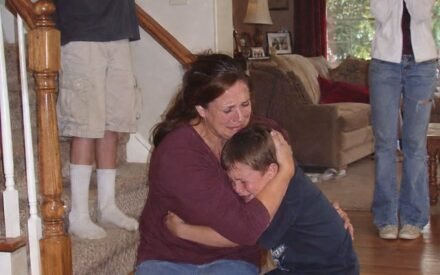
Lucy cried. Max didn’t, which was somehow worse. He just stood in the middle of the grass with dirty hands, staring at the ground, his ears turning red.
I wanted Mark to see what had been done to them. I took two photos through the deck rail, my hands shaking so badly that the second came out slightly blurred. I sent them to him at work with one line: She stood at the fence and made them bring her every apple in our yard.
He called forty seconds later.
“Say it again.”
I said it again. He went quiet for a long moment. I could hear a printer humming somewhere behind him and a door closing.
“Send those photos to my personal email, not my work one,” he said. “And don’t delete them off your phone.”
“Mark.”
“Karen, I need you not to rake this year. Not one apple. Leave every single one exactly where it falls.”
I thought I’d misheard. “What?”
“Don’t rake the apples.”
“Why would I not rake them?”
“Just trust me.”
That is not a sentence husbands should use if they want their wives to stay calm.
“What are you planning?”
“Nothing stupid.”
“That doesn’t answer my question.”
“It does in my head.”
“Mark.”
He exhaled slowly. “I’m going to find out exactly what we’re allowed to do about that tree. And I want proof of what it does to our yard.”
I looked out at the lawn. Lucy had gone inside to wash her face. Max lingered near the fence, scuffing the grass with the toe of his sneaker, pretending he didn’t care.
“You want the apples to stay there as evidence,” I said.
“Exactly.”
That word left me relieved and ridiculous at once. Evidence. Over apples. Then I looked at my son’s face again and understood that this had stopped being about apples the moment she called my daughter a thief.
Mark came home early that afternoon. He didn’t knock on Gloria’s door. He didn’t shout across the fence. He walked straight to the swing set and crouched in the grass, photographing everything. The low branches hanging over our yard. The apples crowded in the flower beds. The dents in the lawn where heavy ones had landed. The brown stain on the shed. Then he started on the fence itself, photographing the slats, the posts, the places where the wood had leaned and been patched over the years. He walked its entire length with his phone held out, slowly, like a man reading a story only he could see.
Gloria appeared on her deck ten minutes later. “Got a photography hobby now?”
Mark didn’t look up. “Just documenting our yard.”
“Those apples are mine.”
He finally turned. “We know. You made that very clear to two little kids.”
“They were taking what’s not theirs.”
“They were playing with fruit that fell into our yard.”
“From my tree.”
Mark stood and brushed off his knees. “Right.”
Something in his tone made her frown. “What does that mean?”
“Nothing.”
She stared at him, then at me, then went back inside and slammed the screen door.
That evening the kids ate dinner without saying much. Lucy pushed her peas around her plate. Max asked whether apples could get a person in trouble. Mark answered before I could.
“No. Never. Not in this house.”
After the kids were in bed, he spread his phone and a folder of printed photos across the kitchen table. Beside them lay a spiral notebook filled with his tight handwriting, every page dated.
“I called the county records office this afternoon,” he said.
“On a Sunday?”
“I left a message. But I also dug out the paperwork from when we bought the house. I’ve never really read the survey. I just signed where they told me to.”
“And?”
He tapped a page showing a drawing of our lot, a rectangle with numbers along its edges and tiny symbols at each corner. “The back edge of our lot doesn’t line up with where the fence is. Not even close.”
“What do you mean, not close?”
“I mean the fence looks like it’s been standing in the wrong place for a very long time.”
I stared at the page, then at him. “Mark. What does that have to do with the tree?”
He looked toward the dark window, where the shape of Gloria’s apple tree rose against her porch light. “I’m not sure yet. But when I went out there today, I found something in the mulch by the back corner. Something I don’t think anyone has looked at in thirty years.” He pushed back his chair. “Come on. I’ll show you.”
Part 2: The Pin in the Mulch
We went out with a flashlight. The night air smelled sweet and sour at once, like cider left too long in a cup. Apples crunched softly under our shoes.
Mark led me to the back corner, past the swing set, where a bed of old cedar mulch had gathered against the fence. He knelt and brushed it aside.
“Look.”
A short metal rod stuck out of the soil, its top capped with a rusty plastic cover that had once been orange.
“What is that?”
“A survey pin. It marks the corner of the property.”
“But that’s behind the fence line. Or in front of it. I can’t tell.”
“It’s on our side of the fence by almost four feet.”
I did the math slowly. Four feet. Gloria’s tree stood near that corner.
“So the fence is on our land,” I said.
“Maybe,” Mark said carefully. “And maybe the tree is, too. I won’t know until a licensed surveyor confirms it. I’m not going to guess about something like this.”
He covered the pin with a piece of slate so nobody would trample it, and we went inside.
The next morning, Lucy wouldn’t go near the fence. I found her on the deck steps with her toy bucket in her lap.
“What’s wrong?”
“Nothing.”
“You wanted to play outside.”
She pointed with her chin toward the apple tree. “I don’t want her to think I’m stealing.”
That did it. I sat beside her and put my arm around her small shoulders. “You are not stealing anything.”
“But she said…”
“Mrs. Whitaker was wrong.”
“Grown-ups can be wrong?”
I nearly laughed. “All the time.”
She considered this very seriously. “Even you?”
“Especially me.”
That earned me a small smile, her first in two days.
Max was different. He acted as if he’d forgotten the whole thing. But that afternoon, when an apple dropped near the swing he was on, he hopped off and walked to the other end of the yard. He didn’t touch it. He didn’t even look at it. Mark saw it from the kitchen window, and I watched his jaw tighten.
“They’re scared of fruit in their own backyard,” he said that night.
“I know.”
“So we stop being polite.”
For the next eleven days we didn’t rake. Every apple stayed where it fell, and each morning I photographed the yard with the date scrawled on a scrap of paper in the corner of the frame. At first it looked almost funny. Five apples. Then nine. Then fourteen. By the second week it didn’t look funny anymore. Some bruised when they hit the ground. Some split open. Wasps began to arrive in lazy, buzzing circles. One apple rolled under the swing and burst beneath Max’s shoe, and he stood very still, staring down at it as if it might accuse him. Another landed hard enough on the shed roof that I heard it from the kitchen, a dull thud like a knock at the door.
Meanwhile Mark hired a licensed surveyor named Walter Pruitt, a quiet man in his fifties with a gray beard and an orange vest. The earliest he could come was twelve days out. Mark booked him without hesitating.
While we waited, Mark wrote Gloria a letter. It wasn’t angry, which annoyed me slightly. It was painfully calm. He wrote that the overhanging branches were dropping large amounts of fruit onto our property, including the children’s play area and the driveway. He noted that Gloria had personally claimed ownership of every fallen apple. Then he wrote my favorite sentence.
Since you have made clear that you consider all fruit from the tree your property, please arrange to collect your property from our yard each evening, or contact us to discuss professional trimming of the branches extending over the boundary.
I read it twice. “That’s petty.”
“Thank you.”
“I didn’t mean it as a compliment.”
“You meant it as one.”
He sent it by certified mail. Gloria received it two days later. We knew because she came straight over. She didn’t ring the bell. She stood at the fence and shouted.
“Mark Dawson!”
He was grilling burgers. He kept flipping one. “Yes, Gloria?”
“What on earth is this letter?”
“Which part confused you?”
“You don’t get to threaten my tree.”
“I’m not threatening anything.”
“You said you’d cut my branches.”
“I said we could discuss professional trimming.”
“You touch that tree and I’ll have a lawyer on you before you can blink.”
Mark nodded. “All right.”
That seemed to throw her. “All right?”
“Then we’ll go with the other option.”
“What other option?”
“You collect your apples.”
She stared at him. “I am not climbing over your fence every night to pick up fruit.”
“Good. Don’t.”
“Then rake them yourself.”
Mark smiled. “Why would I handle your property?”
I turned away so she wouldn’t see me laughing. Her face went the color of a ripe plum.
“You’re being ridiculous.”
He set down the spatula. “No. Ridiculous was making my six-year-old walk four trips across her own yard because you thought she was stealing rotten apples.”
“They were mine.”
“Then come and get them.”
She stalked off muttering. She did not come and get them.
Another week passed. The smell grew worse, and so did the wasps. We kept the kids away from the swing set and spent more afternoons at the park. I hated that. Every day away from our own yard felt like a day she’d won.
Then came the morning Walter Pruitt arrived with a tripod, a long measuring tape, and a metal detector slung over his shoulder. Gloria appeared before he’d finished introducing himself.
“What are you doing in that corner?”
“Boundary survey, ma’am,” Walter said mildly.
“Who hired you?”
“I did,” Mark said.
“You have no right to put stakes in my yard.”
“I’m not putting anything in your yard,” Walter said. “I’m locating the recorded corners of this lot. Everything I do stays on the Dawson side until I have a reason to say otherwise.”
Gloria crossed her arms and planted her feet at the fence, close enough to see the slate stone Mark had moved aside.
Walter worked almost an hour. He swept the detector over the mulch and found the pin. He set up the tripod, sighted along the fence, and ran the tape from the pin to the base of the apple tree. I stood on the deck with my hands pressed to my mouth. Mark stood near the swing set, perfectly still.
Walter measured once. Then he went back to the pin and measured again. He rubbed his beard. He looked at the tape, at his notes, at the tree, at his notes again.
“Mr. Dawson,” he said slowly. “I think you’d better come over here.”
Before Mark could take a step, Gloria’s voice cracked across the yard like a dropped plate.
“Get away from my tree!”
Part 3: Fourteen Inches
Nobody moved. A wasp drifted lazily between us, and the whole yard seemed to hold its breath.
Mark walked to the corner and crouched beside Walter. I followed, my sandals sinking into the soft, sticky mess of fallen fruit. Gloria stayed rigid at the fence, knuckles white on the top rail.
Walter pointed to the tape. One end rested against the metal pin. The other lay along the dark, rough bark of the apple tree’s trunk.
“The recorded boundary runs right here,” he said. “Past the pin, in a straight line to the opposite corner. The fence was built about four feet over on your side. That alone isn’t unusual. Old fences wander.”
“And the tree?” Mark asked.
Walter hesitated. “The center of that trunk is fourteen inches inside your property line, Mr. Dawson.”
I felt the world tilt. “Fourteen inches,” I repeated.
“Over the line, onto your side. The branches leaning over Mrs. Whitaker’s yard are the ones overhanging the wrong way.”
“That’s a lie,” Gloria said.
“It’s a measurement, ma’am,” Walter said gently. “I’ll put it in writing and stamp it. You’re welcome to hire your own surveyor to check my work.”
“That tree has stood there forty years.”
“I believe you.”
“It’s my tree.”
Mark rose slowly. I waited for him to look triumphant. I waited for something sharp. He did neither. He simply looked at her, wearing the kind of tiredness you get after a very long argument you never wanted to win.
“Gloria,” he said, “if the survey holds, then the tree belongs to us. And so does every apple that fell on either side of that fence. Including the ones you made my children carry to you.”
Her mouth opened, and for once no words came out. She’d gone pale in a way I hadn’t expected. The anger drained from her face and left something older behind. She looked at the trunk. She looked at the pin. Then she lowered her eyes to the ground.
“He told me it was fine,” she whispered.
“Who did?” Mark asked.
But she wasn’t talking to him. She was staring at the bark as though somebody stood there.
“Gloria?” I said.
She flinched as if I’d woken her. “You’ve made your point,” she said, her voice thin and brittle. “You and your surveyor and your measuring tape. Congratulations. You can have your tree.”
“I don’t want the tree,” Mark said.
“Then what do you want?”
He took a breath. “I want my kids to be able to play in their own yard. I want an apology that’s not a halfhearted shrug. And I want to understand why a woman who’s lived next to us for years decided it was fine to humiliate two children over fruit.”
She laughed, a small, ugly, cracked sound. “You wouldn’t understand.”
“Try me.”
“No.”
She turned and walked back to her deck, shoulders stiff, and went inside. The door shut. The blinds snapped down, one by one.
Walter cleared his throat. “I’ll have the report ready in three days. Do you want me to set a marker on the actual corner, so there’s no argument later?”
“Please,” Mark said.
Walter drove a fresh stake into the dirt and tied an orange ribbon to it. When he left, I thought the worst was over. I thought we’d won.
But that night Lucy came into our bedroom crying. She’d heard something outside, she said, a scratching and a clink. I carried her to the window. Gloria was in her backyard in her bathrobe, kneeling at the base of the tree with a small garden trowel, digging along the roots on her side of the fence, a flashlight clamped in her teeth.
“What is she doing?” Lucy whispered.
“I don’t know, sweetheart.”
Mark joined us at the window. We watched Gloria work in the thin circle of light for nearly twenty minutes, stopping now and then to wipe her face with her sleeve. Then she sat back on her heels and stayed there, motionless, as if she’d lost something she couldn’t find.
“Should we do something?” I murmured.
“Not tonight,” Mark said. But he didn’t look away.
Three days later the survey report arrived. It said exactly what Walter had said, stamped and signed, with a drawing that showed the tree as a tiny green circle on the Dawson side of a bold black line. Mark read it standing at the kitchen counter and didn’t speak for a while.
“Do you want to call the lawyer?” I asked.
“I want to call her first.”
“Her? After everything?”
He nodded. “If I’m right about what that fence means, this isn’t about the apples at all.”
“What do you think it’s about?”
“I’m not sure. But she said, ‘He told me it was fine.’ Someone told her that. And I’d like to know who.”
That Saturday a knock came at our front door, three slow taps. When I opened it, Gloria stood on the porch in a clean blouse, her hair neatly pinned. She held a worn brown envelope against her chest with both hands. She didn’t look like the woman who’d stood at the fence. She looked smaller, somehow.
“May I come in?”
Mark appeared behind me. “Please.”
She didn’t step inside. She stood on the welcome mat, staring at the envelope, and I realized her hands were trembling.
“I haven’t shown this to anyone in thirty years,” she said.
“What is it?” Mark asked.
She lifted her eyes to his, red around the rims. “It’s the reason I can’t afford to lose that tree. And it’s something you were never supposed to find out about.”
She held the envelope out toward us, and the corner of a faded yellow page slid free.