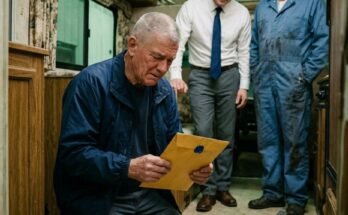
At 10:47 on the night of my twenty-ninth birthday, I lost consciousness on the marble stairs of my husband’s mansion. My hair and clothes were soaked from a mile-and-a-half walk through icy rain. Luca Ferraro managed to catch me before my head hit the steps, but the real shock came moments later. As he pulled off my wet coat, a hospital wristband dropped onto the floor. It carried my maiden name, the previous day’s date, and the name of a children’s hospital. My husband had forgotten the dinner I had planned for us. What he was about to discover was far more serious than a missed reservation.
GetMarriage Tips
My name is Nora Ferraro. Eleven months earlier, I had married Luca, a thirty-eight-year-old billionaire whose interests stretched from shipping and hotels to investment companies. He could bring a room full of executives to silence with one glance, and his employees rarely questioned his instructions. Our marriage, however, was not the result of some sweeping romance. Our families had financial interests to protect, so we signed a carefully drafted agreement. Luca would provide a mansion, security, staff, and twenty-five thousand dollars every month. We would appear together when necessary but otherwise keep separate bedrooms and separate lives.
On the day we signed, Luca looked across the conference table at me.
“I won’t pretend this is a love story, Nora. But you will always have my respect.”
“I understand,” I replied.
For a while, I convinced myself that his promise was enough. He never deliberately humiliated me. He purchased whatever he thought I might need and occasionally remembered a detail that surprised me. Once, he covered me with a blanket when I fell asleep in the library. Another time, he replaced every lily in the house with white roses after discovering I disliked their scent. He also made it clear to a visiting executive that his wife deserved respect whether he was present or not. Those moments were small, almost forgettable to him. To me, they became reasons to hope.
Somewhere between those gestures and the endless evenings I spent alone, I fell in love with my own husband. He continued to live as though the contract had described everything either of us could possibly want. We passed each other in the hall like courteous guests in an expensive hotel. He offered cars, jewelry, and holidays, but rarely offered an uninterrupted conversation. He never seemed to notice that I hardly touched the monthly allowance, or that I had stopped asking whether he would be home for dinner.
For my birthday, I asked for nothing extravagant. I wanted two hours at a small Italian restaurant, without an assistant or a business call between us. I booked a candlelit table, ordered his favorite wine and a modest chocolate cake, and dressed carefully in a blue gown he had once said looked beautiful on me. That morning, Luca mentioned he expected to finish work early, but his phone rang before I could remind him why the evening mattered.
At half past six, the hostess showed me to our table.
At seven, I was still watching the doorway. At eight, I assured the waiter that my husband would arrive shortly. At nine, the candle had been replaced and the ice in his untouched glass had melted. I sent a message and made one call. Neither received an answer. His driver eventually offered to collect me, but I declined because I could not endure someone else’s pity.
The restaurant was closing when the waiter asked whether I wanted to take the cake home. I looked at the delicate icing spelling out Happy Birthday, Nora and shook my head. An empty chair had hurt less than that little cake. After paying, I stepped outside into the storm.
I could have summoned one of Luca’s cars. Instead, I walked. The rain blew sideways, my shoes filled with water, and the cold seemed to settle into my bones. For weeks I had been fighting dizziness and exhaustion. My appetite had disappeared, and there were mornings when simply standing made the room spin. I blamed stress and the medical appointments I had been attending in secret. The previous day a nurse had warned me to rest. I had promised to try, without explaining how difficult that had become.
At a shuttered bookstore, I stopped beneath the awning to catch my breath. My phone lit up, and for one hopeful instant I thought Luca had finally remembered. It was an automated birthday message from a clothing shop.
“Happy birthday, Nora,” I whispered to myself, and carried on.
The mansion was warm and brilliantly lit when I arrived, but it felt more like a museum than a home. Luca was there, already talking about a shipment and a board meeting. I almost walked over and asked whether he realized I had spent the entire evening waiting for him. Instead, I turned toward the staircase. Halfway up, the marble seemed to shift under my feet. My grip loosened, my knees gave way, and the world went black.
The mansion was warm and brilliantly lit when I arrived, but it felt more like a museum than a home. Luca was there, already talking about a shipment and a board meeting. I almost walked over and asked whether he realized I had spent the entire evening waiting for him. Instead, I turned toward the staircase. Halfway up, the marble seemed to shift under my feet. My grip loosened, my knees gave way, and the world went black.
I woke briefly to Luca’s voice, frightened and unfamiliar.
“Nora! Look at me. Please open your eyes.”
“You’re home,” I managed to whisper.
“Of course I’m home. What happened to you?”
“Just the rain.”
“What rain?”
“The walk.”
He noticed the blue dress beneath my soaked coat and finally understood. My birthday. The restaurant. The promise he had made and forgotten. After learning that I had walked a mile and a half, he lifted me into his arms, carried me to my bedroom, and ordered a doctor to come immediately. He canceled his calls, demanded dry blankets and warm towels, and sat beside me holding my hand. That was when the wristband slipped out of my coat.
It was from St. Bridget’s Children’s Hospital, under the name Nora Quinn. The department printed beneath my name read FAMILY DONOR SERVICES. When the family physician, Dr. Samuel Mercer, arrived, Luca demanded an explanation. The doctor refused to discuss my private medical history without my consent. He did, however, examine me and explain that I was dehydrated, my blood pressure was low, and my anemia might have returned.
“How long has she been feeling this way?” the doctor asked.
Luca said nothing.
“Has she been eating? Has she complained of dizziness or weakness?”
“I don’t know,” Luca admitted at last. “We’ve been married for eleven months, and I don’t know.”
I heard his voice break. For the first time, he seemed to understand how thoroughly he had mistaken financial provision for care. When I was awake enough to speak, I told him that the bracelet was mine and that I had been visiting a child named Theo.
“Is he your son?” Luca asked, alarmed.
“No,” I said, too stunned by the question not to laugh. “He’s my little brother.”
Luca looked confused. His investigators had found no brother in my family history, which told me almost everything about how he approached a relationship: he had researched me without ever getting to know me. Theo was my seven-year-old half brother, born after my father Patrick Quinn abandoned our family. Patrick’s second wife, Emily, had contacted me months earlier. Theo had leukemia and needed a stem cell transplant. The doctors had tested me, and I was a potential match.
“I’ve known for months,” I told Luca. “I have been going to appointments and meeting Theo while you’ve assumed I was shopping.”
“Why didn’t you tell me?”
“How was I supposed to tell a man who never asks about my day that my seven-year-old brother might die?”
He sank into the chair. I explained that I had not kept Theo secret because I believed Luca would prevent me from helping him. I simply did not know whether my fears belonged anywhere in Luca’s life. We had eaten dinner together only six times in eleven months. I knew because I had counted. He had given me everything a contract could buy, but I had never felt invited to share the life behind his office door.
The following morning, Luca canceled his schedule. Instead of ordering someone to investigate Theo, he asked me to tell him about the child. I described his dinosaur obsession, his missing front tooth, his hatred of carrots, and the way he joked that losing his hair had made him more aerodynamic. When Luca asked what Theo thought of him, I admitted that my brother had once asked whether my husband was nice and I had answered that I wasn’t sure. Luca closed his eyes. He had finally heard what the marriage looked like from my side.
GetMarriage Tips
Then I told him about another result from my donor assessment. A blood test had suggested I might be pregnant. We had begun as distant strangers, but months earlier a thunderstorm and a long conversation had shifted the boundaries between us. One night had become several, though neither of us had dared name what was changing. Luca had always said he did not want children. His own father, Vittorio, had been harsh and controlling, and Luca feared repeating that pattern.
When I returned to the clinic that afternoon, Luca asked permission to accompany me. The doctor confirmed that I was approximately five weeks pregnant. Luca’s eyes filled as he stared at the ultrasound, while I was pulled between wonder and fear. The medical team explained that pregnancy ruled out my planned donation, and suddenly the joy of having a baby was tangled with guilt over Theo.