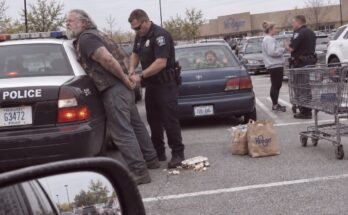
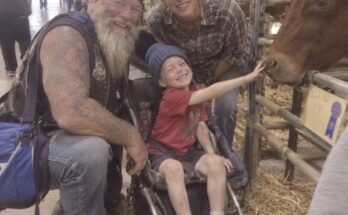
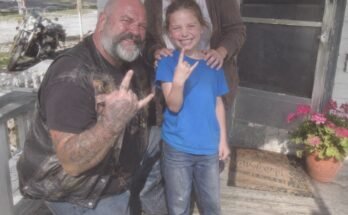
My stepmom sold Dad’s Harley the day after his funeral, the one he promised my son
It was a 1994 Road King. Black and chrome, 140,000 miles, a crack in the left saddlebag from a deer in Montana. Dad rebuilt that engine twice with his own hands.
Every summer since my son Tyler was four, Dad would sit him on that seat in the garage. “When you turn sixteen, buddy, she’s yours,” he’d say. “Not a day before.”
Tyler is fifteen now. He was counting the months.
Dad married Linda six years ago. She never liked the bike. She never liked us much either.
The day after the funeral, I drove Tyler over to pick up a few of Dad’s things. His leather vest. His old Zippo. He wanted to sit on the Harley one more time.
The garage was empty. Just an oil stain on the concrete where she used to sit.
Linda didn’t even look up from her coffee. “I sold it last night,” she said. “Guy from Craigslist. Cash. It’s my property now, and I’m not running a museum.”
Tyler didn’t say a word. He just walked outside and sat on the curb with his face in his hands. I’ve never seen my boy cry like that. Not even at the funeral.
I found the Craigslist ad still up on her phone. The buyer’s name was Hank. He lived two counties over.
I drove there that night without telling anyone. I didn’t know what I was going to say. I just knew I wasn’t going home without that bike.
Hank was about sixty-five, gray ponytail, arms covered in faded ink. He opened his garage door before I even finished explaining.
The Road King was sitting right there. But the seat was off, lying on the workbench.
“I already know who you are,” Hank said quietly. “I was gonna come find you. I paid that woman four grand for this bike, but I can’t keep it. Not after what I found taped under the seat.”
He picked up a yellowed envelope with Tyler’s name written on it in Dad’s handwriting.
“Son, you need to read this before you go back to that house. Your stepmother didn’t sell this bike to get rid of it. She sold it because she was trying to pay for your father’s funeral.”
I stood there in his garage and felt the floor tilt.
“That’s not right,” I said. “The funeral was paid for. Dad had insurance.”
Hank shook his head slowly. He pulled a stool over and pointed at it. I didn’t sit. He didn’t push.
“She told me everything when she handed me the title,” he said. “Sat in my truck and cried for ten minutes. Your old man let his life insurance lapse during the chemo. Couldn’t keep up the payments and the treatments both. He never told her until the end.”
“She would’ve told us,” I said.
“Would she?” Hank looked at me hard. “From what she said, you folks weren’t exactly calling her for Sunday dinner.”
That one landed. He wasn’t wrong.
Hank told me the rest while I stood there holding that envelope.
The funeral home had called Linda the morning after the service. Final balance was due. Eleven thousand dollars. She’d already emptied her checking account for the deposit. She’d sold her mother’s ring the week before. The bike was the last thing in that house worth anything.
“Why so cheap?” I asked. “That bike’s worth three times that.”
“Because she needed it gone fast,” Hank said. “And because she told me she couldn’t stand to haggle over it. Said every minute it sat in that garage, she felt like Walt was watching her do it.”
I thought about her at that kitchen table. Not looking up from her coffee.
I’d figured she was cold. Maybe she just couldn’t look at us.
“She said one more thing,” Hank added. “She said, ‘His grandson’s going to hate me for the rest of his life. Better me than the bank.’”
I didn’t have anything to say to that. My throat had closed up.
Hank nodded at the envelope. “That was taped up under the seat pan, wrapped in a freezer bag. I only found it ’cause I pulled the seat to check the wiring. Your dad hid it somewhere only a man working on that bike would look.”
Tyler’s name was on the front in Dad’s blocky capital letters. TYLER. FOR WHEN SHE’S YOURS.
“I didn’t open it,” Hank said. “Wasn’t mine to open.”
I didn’t open it either.
I sat in my truck in Hank’s driveway for a long time with that envelope on the dash. It wasn’t mine to open. It was Tyler’s.
Hank came out and knocked on my window around eleven. He had two cups of coffee.
“I’ll make this simple for you,” he said. “You bring your boy here. He takes his grandpa’s bike home. I don’t want it.”
“You paid four thousand dollars for it.”
“I did.”
“Then I’ll pay you four thousand dollars.”
He looked at me for a second. “You got four thousand dollars?”
I didn’t. Not sitting around, anyway. I worked in a tire shop. My wife and I had about twenty-six hundred in savings and a truck payment due on the first.
“I’ll get it,” I said.
Hank sipped his coffee. “I’ve been riding since 1977. You know what I learned in all that time? Men who say ‘I’ll get it’ usually mean it. Men who say ‘I’ll try’ never do.” He tapped the roof of my truck. “Take your time. That bike’s not going anywhere.”
I got home after midnight. Tyler was still awake, lying on his bed in the dark with his earbuds in.
I sat on the edge of his bed. He pulled one earbud out but didn’t look at me.
“I found the bike,” I said.
He sat straight up.
“It’s safe. Guy who bought it is a rider. He’s holding it for you.”