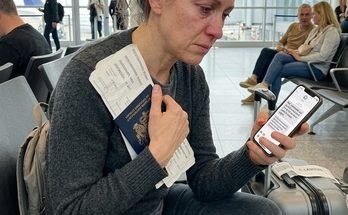
The bank notice stayed in my mind long after Emily shoved the phone back into her purse.
It was not my business anymore.
That was what I told myself as Jake and I walked out of Front Range Galleria that afternoon. The autumn light was gold across the parking lot. Jake carried his medical textbook under one arm and a paper bag of school supplies in the other.
He didn’t say much until we reached the truck.
Then he looked at me and asked, “Are you okay?”
I almost laughed.
For ten years, that had been my question to him.
Now he was asking it of me.
“I am,” I said. “More than I thought I’d be.”
Jake nodded and looked back toward the mall doors.
“She looked scared,” he said.
I started the engine.
“Fear has a way of finding people eventually.”
We drove home in quiet. Not the heavy kind of quiet I used to know after Emily left. This was different. This quiet had room to breathe.
For a few weeks, life returned to normal.
Jake went back to Boulder for classes. I worked at Colorado Alloy Works, now as a technical supervisor instead of the man taking every night shift available. In the evenings, I made coffee, checked the mailbox, and sat by the fireplace with the kind of peace I once thought belonged only to other people.
Then one winter evening, the landline rang.
I almost didn’t answer. Most people called my cell now.
But the old phone kept ringing.
Jake was home for the weekend, sitting on the couch with a medical book open on his lap.
“You want me to get it?” he asked.
I shook my head and picked it up.
“Hello?”
For a second, there was only static.
Then Ryan’s voice came through, low and smug.
“Big bro.”
The old nickname made my grip tighten.
“What do you want, Ryan?”
He laughed softly.
“You should thank me, you know.”
I said nothing.
“Because of me, you saw who Emily really was,” he continued. “I saved you from wasting your whole life on her.”
His voice had that same slippery confidence, but something underneath it sounded cracked.
“What did you do?” I asked.
Another laugh.
“She’s got nothing left, Andrew. Nothing. Tell her I said good luck.”
The line went dead.
I stood there with the receiver in my hand, listening to the empty tone.
Jake closed his book.
“Dad?”
Before I could answer, someone pounded on the front door.
Not knocked.
Pounded.
Three desperate hits that rattled the frame.
I walked over slowly.
When I opened the door, Emily was standing on my porch.
For a moment, I barely recognized her.
The woman who had strutted through Front Range Galleria in a designer coat was gone. Her hair was tangled from the wind. Her thin jacket was torn near the shoulder. Mud stained her shoes. Her face looked pale and exhausted, with dark circles under both eyes.
Snow gathered on her sleeves.
“Andrew,” she said.
My name came out like a plea.
Behind me, Jake stood up from the couch.
Emily saw him and lowered her eyes.
No one spoke for several seconds.
The cold pushed into the hallway around her.
I did not love her anymore.
I did not trust her.
But I was not the kind of man who could leave someone freezing on a porch.
“Come in,” I said.
She stepped inside like she expected the house itself to reject her.
Jake stayed near the fireplace, quiet, his hands at his sides.
Emily sat on the edge of the armchair and stared at the floor.
Then she began to cry.
Not the graceful crying of someone asking to be forgiven.
It was broken, ugly, frightened crying.
“I have nothing left,” she said. “Ryan took it all.”
I stood across from her.
Jake did not move.
Emily pulled a folded stack of papers from her purse and laid them on the coffee table. Loan documents. A foreclosure notice. A copy of a wire transfer confirmation. Her name was on almost every page.
Ryan had convinced her to put their apartment in Aurora under her credit.
Then he convinced her to sign for business loans.
Then he convinced her to move money into accounts he controlled because, according to him, investors trusted a single name better than a joint account.
“He said we were building something,” Emily whispered. “He said we were close to being rich.”
I looked at the papers.
Ryan’s name appeared only where it protected him.
Emily’s name appeared where it could destroy her.
“He left with another woman,” she said. “Younger. From Denver. He emptied the accounts and disappeared.”
Jake’s jaw tightened.
Emily looked at him, tears running down her face.
“Jake, I know I don’t deserve—”
“No,” Jake said quietly.
She stopped.
His voice was calm, but I could feel the years inside it.
“You don’t get to start with what you deserve.”
Emily covered her mouth.
“I was wrong,” she said. “I know that now. I was selfish. I thought your father was holding me back. I thought Ryan was giving me a life.”
She turned to me.
“Andrew, please. I don’t have anywhere else to go.”
The room became very still.
The fireplace cracked behind us. Snow tapped softly against the window. On the coffee table, the foreclosure notice lay beside one of Jake’s medical textbooks, and the difference between those two objects said everything.
One was what she had chosen.
One was what I had protected.
I remembered the night she left.
Jake in the hallway.
His little voice asking where his mother went.
I remembered sitting beside his hospital bed, counting every breath because I was terrified one might not come.
I remembered my parents telling me to let it go.
I remembered folding Emily’s letter and keeping it in a drawer for years because pain sometimes becomes proof that you survived.
Emily reached toward me.
“I want to come home,” she whispered.
I looked around the room.
This was not her home.
This was the place Jake and I had built from overtime, medicine bills, burnt breakfasts, library books, hospital bracelets, and quiet promises.
This house had held our grief.
It had earned its peace.
“You can’t come back here,” I said.
Emily stared at me as if she had not understood.
“Andrew, please.”
“You left a child who needed you,” I said. “You took money meant for his treatment. You let my brother mock me for raising him. And now you are here because Ryan did to you what you both did to me.”
Her tears fell harder.
“I’m sorry.”
“I believe you’re sorry,” I said. “But I don’t believe you came back because you understood what you broke. You came back because you ran out of places to stand.”
Jake looked down.
That hurt him. I could tell.
But he did not ask me to stop.
Emily turned to him again.
“Jake, please. I’m still your mother.”
Jake looked at her for a long time.
Then he said, “A mother is not just a name.”
The words were quiet.
They broke whatever hope Emily had left.
She lowered her head and cried into her hands.
I picked up the loan documents and placed them back in front of her.
“You need an attorney,” I said. “A shelter. A legal aid office. I can give you phone numbers. I can drive you somewhere safe tonight. But you cannot stay here.”
She looked up.
There was no hatred in my face.
That seemed to confuse her more than anger would have.
I meant what I said. I was not throwing her into the snow. I was drawing a line around the life Jake and I had fought too hard to protect.
I called a local women’s shelter in Greeley and explained that someone needed emergency help. Then I wrote down the number for a legal aid office that handled debt and foreclosure cases.
Emily sat silently while I did it.
When the shelter confirmed they had a bed, I grabbed my truck keys.
Jake stood.
“I’m coming with you.”
Emily looked at him, startled.
He did not soften.
“I’m not coming for you,” he said. “I’m coming for him.”
The drive was quiet.
Emily sat in the back seat, holding the papers in her lap like they were all that remained of her life. Snow streaked across the windshield. The streets of Greeley glowed under yellow lamps.
At the shelter entrance, she paused before stepping out.
“Andrew,” she said. “Did you ever hate me?”
I kept both hands on the steering wheel.
“For a while,” I said. “Then I got too busy raising our son.”
She flinched.
That was the truth, and the truth did not need to be loud.
Emily nodded once, then looked at Jake.
He gave her nothing cruel.
Only distance.
She walked inside carrying the documents Ryan had left her with.
I never saw her again after that night.
Months later, I heard through someone in town that Emily had entered a treatment program after exhaustion and stress took a toll on her. I also heard that the foreclosure went through and that she was trying to rebuild her life from nothing.
I did not celebrate it.
There was a time when I might have wanted to.
But by then, revenge felt too small for the life I had.
Ryan vanished for nearly a year.
Then a creditor called my parents’ old house in Pueblo looking for him.
That was how they found out their golden son had used their names too. A second mortgage application. A business guarantee. A forged signature my father swore he never wrote.
My mother called me one Sunday evening.
Her voice sounded older than I remembered.
“Andrew,” she said, “we were wrong.”
I stood by the kitchen window, watching Jake’s old kite hang from a nail in the garage.
She began to cry.
“We defended him all our lives,” she said. “And you were the one we blamed.”
I closed my eyes.
For years, I had imagined that apology.
I thought it would heal something instantly.
It didn’t.
It only landed softly on a place that had already scarred over.
“I hope you’re safe,” I said.
“Can we see you?” she asked.
I looked into the living room, where Jake was reading on the couch with a pencil between his fingers, grown now but still the center of my world.
“Not yet,” I said.
It was the kindest truth I had.
Over time, I called my parents once in a while. Short calls. Polite. Distant. I helped them find someone to review the documents Ryan had dragged them into, but I did not become their emotional shelter.
They had taught me too well what it felt like to stand alone.
I would not be cruel.
But I would not go back to being the son who carried everyone else’s mistakes.
Years passed.
Jake graduated with honors.
At his ceremony in Boulder, I sat in the crowd wearing the best suit I owned, my hands folded tightly in my lap. When his name was called, he walked across the stage in a black gown, tall and steady, and took his diploma.
For a second, I saw him at nine years old again.
Small hands around an inhaler.
Eyes bright over a library book.
“Dad, lungs are like machines, right?”
Now he was becoming a respiratory doctor.
A man who had once fought for every breath had chosen to spend his life helping others find theirs.
After the ceremony, he found me in the crowd and hugged me hard.
“We did it,” he said.
Not I.
We.
That one word paid me back for every night shift, every overdue bill, every silent drive through snow, every moment I had wondered if love alone could be enough.
Jake moved to Boulder for his residency, but he came home almost every weekend.
Sometimes he brought laundry.
Sometimes he brought stories about patients.
Sometimes he only came to sit on the porch with me while the Colorado evening turned blue over the yard.
One winter morning, years after Emily knocked on my door, I cleaned out an old drawer and found the letter she had left on the kitchen table.
I had kept it all that time.
Not because I still loved her.
Not because I needed to remember the pain.
But because, for years, that letter had been the line between the life I lost and the life I built.
I unfolded it once more.
I’ve chosen a man who knows how to live.
Don’t look for me.
I don’t belong here anymore.
I read it without shaking.
Then I placed it beside an old hospital bracelet of Jake’s, a faded school photo, and the acceptance letter from the University of Colorado.
For the first time, I saw the truth clearly.
Emily had not taken my life when she left.
She had walked out of it before she could destroy what mattered most.
I carried the letter to the fireplace.
Jake was home that weekend, making coffee in the kitchen.
He saw it in my hand.
“You sure?” he asked.
I nodded.
“I don’t need proof anymore.”
He stood beside me as I placed the letter into the fire.
The paper curled slowly, the ink darkening before it disappeared.
Neither of us spoke.
We didn’t need to.
Outside, snow fell over the quiet street in Greeley. Inside, the house was warm. The same house that had heard our worst nights now held our peace.
Jake handed me a cup of coffee.
“To breathing easier,” he said.
I smiled.
“To breathing easier.”
And that was how the story ended for me.
Not with Ryan begging.
Not with Emily ruined.
Not with my parents finally admitting what they had done.
It ended in a small house, beside a fireplace, with my son standing next to me — healthy, kind, grown, and still coming home.
Life can take your money, your pride, your trust, even the people you thought would never leave.
But sometimes, if you keep standing, it gives you something quieter and stronger in return.
A home no one can steal.
A child who knows what love really looks like.
And a peace that does not need anyone’s apology to be real.