He never glared at me or made an openly threatening gesture.
Somehow, that calm movement unsettled me more than obvious hostility would have.
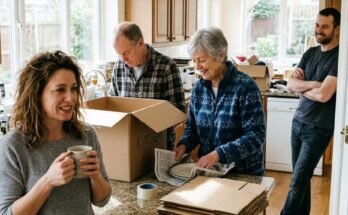
One evening, I noticed him carrying a cardboard box toward his car.
“Doing some cleaning?” I asked.
“Marjorie has too much clutter,” he replied.
“She loves her things.”
“She gets tired easily now.”
His voice was mild, but the conversation ended there. He placed the box in his trunk and closed it before I could see what was inside.
Then, one morning, I spotted Marjorie outside for less than a minute.
She was standing near her rose bushes in a pale nightgown, even though the air was cold enough to require a coat.
She looked noticeably thinner.
Her skin was pale, and she appeared exhausted, almost as though she hadn’t slept properly in days.
I dropped the garden hose I had been winding beside my garage.
“Marjorie?”
She lifted her head.
For one hopeful moment, I thought she might walk toward me.
But before I could reach her, Owen appeared beside her, gently took her arm, and began leading her back inside.
“She needs to rest,” he said.
“Marjorie, are you all right?” I called.
She glanced over her shoulder.
Just for a second.
Her smile disappeared.
Then the door closed before she could answer.
That evening, I couldn’t stop thinking about the expression on her face.
I tried to convince myself that there was probably a reasonable explanation.
Older people lose weight. They become tired more easily. Sometimes they need more assistance than they are willing to admit.
Owen hadn’t done anything openly threatening, and accusing someone based on closed curtains and a frightened glance seemed irresponsible.
Still, I barely slept that night.
Two days later, something happened that made my concerns even stronger.
A pharmacy called me by mistake.
“Hello, is this Marjorie’s emergency contact?” a woman asked.
“No, this is Ariel. I live next door.”
The woman explained that Marjorie’s medication was ready for collection.
When I told her she had the wrong number, the pharmacist apologized and mentioned that Owen had recently changed Marjorie’s emergency contact information.
I immediately tightened my grip on the phone.
“Changed it from whom?”
“I’m sorry, I can’t discuss private records.”
“Then why do you have my number?”
There was a brief pause.
“It may have remained in an older section of the file.”
I felt a knot forming in my stomach.
Three years earlier, Marjorie had given me a spare key to her house after accidentally locking herself out while taking the trash outside.
She had pressed it into my palm and refused to take it back.
“You are the most reliable person on this street,” she had told me.
I had never needed to use it.
Until that afternoon.
I Used the Spare Key and Walked Into a House That Didn’t Feel Like Hers
I knocked several times.
There was no answer.
“Owen?” I called. “Marjorie?”
His sedan wasn’t in the driveway, but instead of reassuring me, its absence made the silence feel even more unsettling.
I finally took out the spare key and unlocked the front door.
The moment I stepped inside, something felt wrong.
The house was spotless.
Almost unnaturally spotless.
The familiar floral cushions had disappeared. The stack of magazines beside Marjorie’s favorite chair was gone. Even the little ceramic bowl where she kept peppermints had been removed.
Then I noticed something even stranger.
Every family photograph had vanished from the walls.
“Marjorie?” I called again.
Nothing.
Then I heard something.
A faint voice coming from upstairs.
I immediately hurried toward her bedroom.
My hand closed around the doorknob.
The door slowly swung open.
For a moment, I couldn’t understand what I was looking at.
Marjorie was sitting upright against the headboard, wearing the same pale nightgown I had seen her wearing two mornings earlier.
A tray rested across her lap, but the bowl of soup sitting on it appeared untouched.
Her hands were trembling around a folded piece of paper.
The room smelled faintly of antiseptic.
“Ariel?” she whispered.
I rushed toward her bedside.
“Marjorie, what happened? Are you hurt?”
Her eyes immediately filled with tears.
She shook her head and glanced nervously toward the hallway.
“You shouldn’t be here.”
The fear in her voice frightened me more than anything else I had seen.
I lowered myself beside the bed.
“Why not?”
“Because Owen will come back.”
“Then let him.”
She reached for my wrist. Her fingers felt unusually cold.
“You don’t understand.”
Before I could ask another question, the front door opened downstairs.
Marjorie froze.
Footsteps moved through the entryway.
“Ariel,” she whispered desperately. “Please hide.”
Every instinct told me to call the police, but my phone was downstairs on the kitchen counter. I had dropped it there when I rushed toward her voice.
The footsteps reached the staircase.
I quickly moved behind the bedroom door just as Owen entered.
He stopped when he noticed Marjorie sitting upright.
“What are you doing?” he asked.
His voice was still soft, but the warmth I had once heard in it was gone.
“I was thirsty,” Marjorie answered.
“There’s water on your table.”
Owen crossed the room and lifted the untouched glass.
Then he noticed the paper in her hands.
“Give me that.”
Marjorie pressed it against her chest.
“No.”
His expression hardened.
“Marjorie.”
I stepped out from behind the door.
“She said no.”
Owen spun around.
For the first time since I had met him, he looked genuinely shaken.
“What are you doing in this house?” he demanded.
“I have a key.”
“You need to leave.”
“So do you.”
His expression changed immediately. The polite young man I had seen carrying groceries had disappeared, replaced by someone far less welcoming.
“You have no idea what’s going on.”
“Then explain it.”
Marjorie began crying quietly.
Owen looked at her, and some of the anger seemed to drain from his face.
He walked over to the chair near the window, sat down, and rubbed both hands over his face.
“I told you this would happen,” he said to her.
“I couldn’t keep lying,” Marjorie replied.
I stared at them both.
“Lying about what?”
Neither answered.
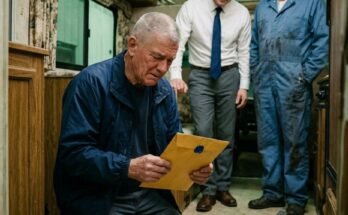
I reached toward the paper in Marjorie’s hands, but she hesitated before finally passing it to me.
It was a legal document.
At the top were four words that immediately made my stomach tighten.
“Last Will and Testament.”
I began reading.
Marjorie’s name appeared throughout the document, along with Owen’s.
She had left him the house, her savings, and nearly everything she owned.
I looked at her in disbelief.
“Did you sign this willingly?”
“Yes,” she answered.
Owen closed his eyes.
That was not the answer I had expected.
“Then why are you afraid of him?” I asked.
Marjorie lowered her gaze.
“I’m not afraid of Owen.”
“Then why did you look terrified?”
She hesitated.
“I was afraid you would find out.”
The room seemed to tilt beneath me.
“Find out what?”
Marjorie looked toward Owen, but he remained silent, staring at the floor.
Then she wiped her cheeks with the back of her hand and revealed something I never could have imagined.
The Shocking Family Secret Behind Owen’s Visits
“His mother was my daughter.”
For a moment, I couldn’t breathe.
I stared at Marjorie, trying to understand what she had just said.
“You told me you never had children.”
“I told everyone that.”
Owen walked toward the window and slowly pulled the curtain aside.
A thin line of sunlight entered the room.
Marjorie continued, her voice breaking.
“I was 17 when I gave birth to her. My parents sent me away. They told people I was visiting relatives. When the baby came, they arranged an adoption before I even had the chance to hold her properly.”
I sat down beside her again.
She pressed her lips together, struggling to continue.
“Her name was Ruth. I found her years later, but she wanted nothing to do with me. I don’t blame her. She had spent her entire life believing I had abandoned her.”
Owen finally spoke, although he still wasn’t facing us.
“My mother died last year.”
His voice cracked on the final word.
I looked at him, suddenly recognizing the grief hidden beneath his carefully controlled behavior.
“Before she died, she gave me Marjorie’s name,” he continued. “She told me not to contact her.”
“But you did,” I said.
“Yes.”
Marjorie reached toward him.
“And I thank God for that every day.”
I looked around the room again, at the closed curtains, empty walls, and spotless shelves.
Suddenly, all the things I had found suspicious seemed connected to something I hadn’t understood.
“What happened to the photographs?” I asked.
Owen finally turned around.
“They were Ruth’s.”
Marjorie nodded.
“I had kept every photograph I could find. School pictures, newspaper clippings, even a copy of her wedding announcement. Owen found them.”
She paused before continuing.
“He thought I had been watching his mother from a distance. He thought I had deliberately chosen to remain silent.”
“I did think that,” Owen admitted.
This time, his anger seemed directed toward himself.
“I came here wanting answers. Then I learned the truth. Her parents threatened her. They told her she would be homeless if she refused the adoption. She spent decades trying to find my mother.”
I looked at Marjorie.
“Why did you stop coming outside?”
Her eyes shifted toward the medication tray.
“Because I’m sick.”
Owen picked up a folder from the dresser and handed it to me.
Inside were medical test results, hospital notes, and a schedule of upcoming appointments.
The diagnosis was written clearly.
Pancreatic cancer.
Advanced.
I read the words twice before I could fully understand them.
Marjorie watched my expression and whispered something that broke my heart.
“I didn’t want the neighborhood to know.”
My throat tightened.
“Why?”
“Because I didn’t want to become the dying woman at the end of the street.”
She managed a faint smile.
“I wanted to remain the woman who baked peach pies.”
I looked toward Owen.
“And the curtains?”
“She became sensitive to light after treatment,” he explained. “And she didn’t want anyone seeing how weak she looked.”
“What about the emergency contact?”
“She asked me to change it.”
A wave of shame washed over me.
Every detail I had interpreted as a warning sign had a different explanation.
But one question was still bothering me.
“Why did you always close the curtains whenever I waved?”
Owen’s expression softened.
“Because she cried every time she saw you.”
Marjorie covered her mouth.
“I knew I had lied to you,” she said. “You had been kinder to me than most of my own family. I was ashamed.”
I reached for her hand.
“You didn’t owe me your past.”
“But I owed you the truth.”
The front door remained open downstairs, and cool air drifted through the house. Somewhere outside, a lawn mower started.
That ordinary neighborhood sound made the entire moment feel even more heartbreaking.
Owen sat across from us.
“I wasn’t taking her things,” he explained. “She asked me to pack them. She wants the house prepared before she goes into hospice.”
I glanced down at the will again.
“And she wants you to have everything?”
Owen shook his head.
“I told her I don’t want it.”
Marjorie managed a small laugh.
“He has argued with me every day.”
“Because I came here for answers,” Owen replied. “Not money.”
She looked at him with a tenderness I had never seen on her face before.
“You came because some part of you hoped your mother had been loved.”
Owen’s eyes filled with tears.
“She was,” Marjorie whispered. “Every day of her life.”
He bowed his head.
I moved closer to Marjorie and carefully wrapped my arms around her.
She felt fragile, but she held me with surprising strength.
“I’m sorry I came in without permission,” I whispered.
She rested her cheek against mine.
“No. I gave you that key for a reason.”
The Final Weeks of Marjorie’s Life Changed All of Us
Over the following weeks, the truth spread only as far as Marjorie wanted it to.
Mrs. Bell began bringing casseroles. The pharmacist corrected the emergency contact information. Owen started opening the curtains each morning, although he only pulled them halfway.
Marjorie never returned to her porch.
Instead, I began spending time beside her bed, listening to stories she had kept buried for more than 60 years.
Owen listened, too.
Sometimes he asked questions. Other times, he quietly left the room because the emotions became too much.
There were things he had never known about his mother, and there were things Marjorie had never been able to tell anyone about the daughter she had lost.
For the first time, they were able to share those memories together.
On her final Sunday, Marjorie made a request.
She wanted us to bake a peach pie together.
Owen ruined the crust.
I accidentally added too much cinnamon.
Marjorie took one bite, looked at us, and delivered her verdict.
“Awful.”
We laughed until all three of us were crying.
It was one of the last genuinely happy moments we shared with her.
Two nights later, Marjorie passed away.
Owen was holding one of her hands, and I was holding the other.
After the funeral, Owen made a decision that surprised me.
He didn’t sell the house.
Instead, he moved in.
Every Sunday, he now bakes a peach pie using Marjorie’s original recipe.
His crust is still uneven, but the familiar smell drifts through my kitchen window just before noon.
And every morning, whenever I leave for work, he stands on the porch and waves.
Now, I always wave back.