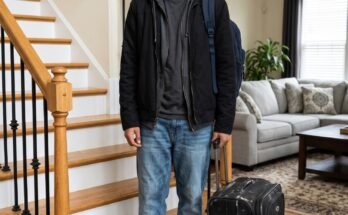
The living room smelled of old pizza and stale air-conditioning while my mother and Kelsey slept comfortably under blankets on the couch. Empty soda bottles, chip bags, and pizza boxes covered the coffee table, as though they’d spent the whole night relaxing instead of helping a recovering mother and newborn.
My mother woke with a start when she saw me and immediately demanded to know why I hadn’t warned them I was coming home early. I ignored her and demanded to know where Hannah and Theo were. Mom casually replied that Theo had cried all night and Hannah was probably asleep now.
Then I heard Theo. Not an ordinary cry. A weak, fractured sound from behind the bedroom door. I ran down the hallway.
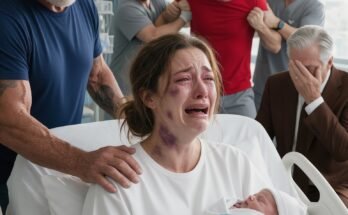
The smell reached me before I got to the bed: sour milk, sweat, stale diapers, blood, and overheated air trapped in a sealed room. Hannah lay completely still on one side of the mattress while Theo lay beside her in a dirty blanket. The windows were shut tight, the fan was off, and Hannah’s face looked gray in the early light. One hand hung weakly over the edge of the bed as though she’d tried to pull herself up and failed.
When I pressed my palm to Theo’s forehead, intense heat struck it. He barely responded when I lifted him. Hannah was burning with fever too, but she wouldn’t wake no matter how firmly I shook her shoulder.
I screamed for my mother. She and Kelsey hurried to the doorway, but their reaction horrified me most. Neither rushed toward Hannah or reached for Theo. They simply stood frozen, like people suddenly faced with evidence they’d never imagined anyone else would find. My mother insisted Hannah had seemed fine the night before, and Kelsey nervously suggested she might be exaggerating everything for attention.
Hearing those words while my wife and newborn son burned with fever nearly broke something in me forever.
I wrapped Theo in my hoodie, lifted Hannah into my arms, and rushed barefoot outside, yelling for help. Our neighbor Mr. Doyle stepped out immediately, saw their condition, and grabbed the keys to his SUV without asking one pointless question.
During the ride, Hannah’s head rested weakly against my shoulder while Theo grew quieter and quieter in my arms. I repeated his name over and over, because his silence frightened me more than his crying ever could.
At 5:42 a.m. we rushed through the emergency room doors carrying everything I loved most in the world.
Part 4: The Messages on Kelsey’s Phone Changed Everything
The emergency room moved fast once the nurses grasped how serious things were. Hannah was placed on a stretcher because she could barely respond, while Theo was rushed to pediatric evaluation with a dangerously high fever. A nurse fastened an emergency bracelet around his tiny ankle and wrote 7 DAYS OLD, FEVER across his chart, and seeing those words made reality hit harder than anything else that morning.
While doctors examined Hannah behind a curtain, another physician carefully checked Theo and removed the filthy blanket wrapped around him. The instant she saw his condition, her expression hardened. She asked who’d been responsible for looking after my wife and son while I was gone, and when I explained that my mother and sister had stayed with them, she turned to the nurse beside her and quietly said, “Call the police.”
My mother and Kelsey reached the hospital only minutes later. Both were crying, but something about them felt wrong at once. Rather than rushing over to ask about Hannah or Theo, they immediately began defending themselves. My mother insisted Hannah had been difficult and emotional after childbirth, while Kelsey quietly repeated that they’d tried their best to help.
The doctor stared straight at them and repeated, “Your best?” with such disbelief that both women visibly squirmed.
A nurse then asked whether I still had Hannah’s discharge paperwork. I suddenly remembered the instruction folder and panicked, until Mr. Doyle helped me search the diaper bag I’d brought from home. Inside we found the folded papers with the warning section circled in blue ink, by me, before I left town. The instructions clearly said caregivers had to call immediately if Hannah developed fever, serious weakness, dehydration, fainting, or signs of infection.
My mother stared at the pages in silence, because she recognized my handwriting at once. There was no question about whether she’d seen those warnings. I’d circled them myself before leaving, and both she and Kelsey knew exactly which symptoms demanded immediate medical attention.
When police officers arrived, they asked detailed questions about the timeline, the phone conversations, and everyone who’d been inside our house over the previous four days. I handed over my phone and showed them call records, messages, and Kelsey’s final text from earlier that night saying everyone was sleeping and I needed to stop worrying.
Then Kelsey’s phone vibrated. The reaction on her face was immediate and unmistakable. She looked terrified the instant she saw the screen, and both the officer and I noticed it. When the officer asked what message had come in, Kelsey answered far too quickly that it was nothing important. My mother snapped her name sharply, and that single reaction told me both women were hiding something.
Later, investigators found the messages saved on Kelsey’s phone, and those conversations destroyed every remaining excuse my mother tried to offer. They showed Hannah repeatedly asking for water, food, and help while Kelsey complained that Theo was constantly crying. Instead of concern, my mother repeatedly described Hannah as dramatic and manipulative. One message from my mother read, Let him cry. She wanted to be a mother. Another said, Don’t call Evan. He’ll take her side.
The most disturbing came from the night before I returned. Kelsey texted our mother that Hannah looked seriously ill, and my mother answered simply: She’s acting. Leave her.
Reading those messages changed something in me forever. My mother hadn’t neglected Hannah because she failed to see the danger. She’d deliberately ignored her because she believed Hannah deserved to suffer for refusing to behave the way she expected.
The doctor came back later and explained that Hannah was severely dehydrated and fighting a dangerous infection. Theo’s fever had also become life-threatening, because infections in newborns can worsen with terrifying speed. She told me that getting them to the hospital when I did had probably saved both their lives.
Even after hearing that, the guilt stayed, because I kept replaying the moment I chose work over staying home. I’d trusted the wrong people simply because they were family, and that trust had nearly cost my wife and son everything.
At one point Mr. Doyle came quietly back from the house carrying another grocery bag he’d retrieved with police permission. Inside were unopened baby formula, Hannah’s unused medication, a sealed water bottle, and the discharge instructions I’d marked before leaving town. Those items proved something painful and undeniable: everything Hannah needed had been sitting only a few feet away while she and Theo grew sicker in that overheated bedroom.
My mother finally cried harder once the evidence came out, but even then I recognized the difference between guilt and exposure. She didn’t seem devastated that Hannah had nearly died. She seemed terrified because everyone around her finally understood what had happened inside that house.
Kelsey eventually broke down entirely and admitted that my mother had repeatedly told her not to contact me, because Hannah was supposedly exaggerating her condition for attention. My mother turned on Kelsey in fury for speaking honestly in front of the police, and the officers quickly separated them before the argument could escalate.
Shortly afterward the doctor returned one last time and called my name. The moment I saw her face, I knew that whatever she said next would decide whether my family survived that morning.