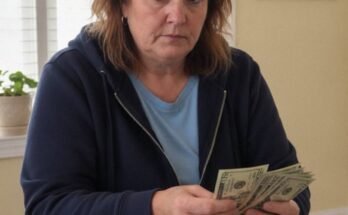
“Because I need to show you something.”
“Mom, are you in trouble?”
“No.”
“Are you sick?”
“No.”
“Is somebody taking money from you?”
“No.”
“Then what?”
“Tomorrow.”
I barely slept.
By the time I got to her house the next evening, I’d imagined everything.
Debt. Scam. Gambling. Someone threatening her.
A secret medical bill.
Mom opened the door before I knocked.
“Come in.”
She looked normal.
That almost made it worse.
On the kitchen table sat a metal cash box.
I stared at it.
“What is that?”
“Sit down.”
“Mom.”
“Please.”
I sat.
She opened the box.
Inside were envelopes.
A lot of them.
Each had a date written across the front.
And one thing printed at the top in black marker: “CALEB.”
I looked at her.
“What is this?”
She took out the first envelope.
Forty dollars.
Then the next.
Forty dollars.
Every payment we’d given her was still there.
I stared. “You kept all of it?”
“Yes.”
“Why?”
She pushed a small notebook toward me.
I opened it.
Dates. Amounts. Notes.
One entry said:
“Thursday, School meeting – $40.”
Another, “Saturday wedding – $40.”
Then I saw a total at the bottom.
It was much higher than the amount we’d paid.
“Why is there more money here?”
Mom folded her hands.
“Because I’ve been adding to it.”
My irritation disappeared.
“What is this for?”
She looked down.
Then said, “For Caleb.”
I stared at her.
“Obviously. His name is on every envelope.”
“No.”
Her voice softened.
“For later.”
I still didn’t understand.
Then she reached into the cash box and pulled out a brochure.
It was from a pediatric hospital foundation.
I looked at the front. Then at her.
“What is this?”
Mom swallowed.
“Do you remember when Caleb was three and had that heart murmur?”
My chest tightened immediately.
Of course I remembered.
At one of his checkups, his pediatrician heard something.
We spent almost two weeks terrified.
Then the cardiologist told us it was an innocent murmur.
Nothing dangerous. Nothing that required treatment.
I still remembered crying in my car afterward from relief.
“Yes.”
Mom nodded.
“Do you remember the little boy in the waiting room?”
I frowned.
There had been a lot of children.
Then I vaguely remembered one.
Maybe five years old. Thin. Wearing a red superhero cape.
“Sort of.”
“His name was Noah.”
I looked at Mom.
“How do you know that?”
She went quiet.
Then I remembered.
Mom had gone with us to one of the appointments.
Ryan couldn’t get off work, and I had been too nervous to go alone.
Mom continued.
“His grandmother and I talked while you were with the doctor.”
I waited.
“Noah had a congenital heart condition. He’d already had two surgeries.”
My stomach tightened.
“Okay.”
“His grandmother told me they were drowning.”
“Financially?”
“Everything.”
She rubbed her thumb across the edge of the brochure.
“His mother had reduced her hours. His father had lost his job. They had insurance, but not enough.”
I still didn’t understand what this had to do with Caleb or $40.
Mom said:
“That day scared me.”
“I know.”
“No, not only because of Caleb.”
She looked at me.
“I realized how lucky we were.”
The “we” got me.
Not you.
Us.
“Caleb walked out healthy.”
I nodded.
“That little boy didn’t.”
I felt cold.
“Mom…”
“He died the following year.”
I closed my eyes.
“I didn’t know.”
“I found out because his grandmother sent me a Christmas card.”
“What?”
Mom gave a sad little smile.
“We exchanged numbers that day.”
Of course she had.
My mother could make a friend in a pharmacy line.
She continued.
“After Noah died, his family started a small fund through the hospital. It helps families with food, parking, hotels, things insurance doesn’t cover.”
I looked at the brochure again.
Then the envelopes.
Then her.
“You’re donating the babysitting money?”
“Not exactly.”
I waited.
“I’m matching it.”
I frowned.
“What?”
“Every time you pay me $40, I put in $40 of my own.”
That explained the total.
My throat tightened.
“But why make us pay?”
Mom looked uncomfortable.
This, apparently, was the part she had been avoiding.
“Because I wanted it to become Caleb’s money too.”
I stared at her.
“That doesn’t make sense.”
“I know it sounds strange.”
“It does.”
She nodded.
Then pulled out another paper.
It was a simple savings chart.
At the top:
CALEB’S HELPING FUND.
I felt something in my chest shift.
Mom said:
“When he turns ten, I want to tell him about it.”
“Tell him what?”
“That every time he came to Grandma’s house, part of that day helped another family.”
I didn’t say anything.
She continued quickly.
“Not because he owed anyone. Not because you owed me. I just…”
She struggled.
“I wanted him to grow up knowing ordinary things can help somebody.”
I looked at the envelopes again.
“Then why not just ask us to donate?”
“Because you would’ve said yes once.”
I almost laughed.
She wasn’t wrong.
“You would’ve sent a $100, felt good, and moved on.”
“Probably.”
“I wanted it to continue.”
“Then why not tell me?”
She looked down.
“Because I wanted to surprise you.”
I stared.
“For two months?”
She winced.
“It worked better in my head.”
That actually made me laugh.
A real laugh this time.
Mom smiled carefully. Then I got serious again.