For several seconds, I couldn’t move.
Neither could anyone else.
Grant looked at me.
His face was a mixture of pride and fear.
Then he finally explained.
He had secretly completed the police academy.
He hadn’t told the family because he was terrified that if he failed, everyone would know.
So instead, he had planned to reveal it on my birthday.
He had asked Officer Nate to deliver the note and bring me to the community center because he thought the dramatic entrance would make the surprise unforgettable.
It certainly was unforgettable.
Just not for the reasons he imagined.
There had been no attorney waiting for me.
No insurance emergency.
No mortgage crisis.
No failed investment.
No family estate dispute.
No court case.
Thankfully, there wasn’t even a real emergency.
The entire terrifying mystery had been caused by one badly planned birthday surprise.
But Grant hadn’t considered one thing.
I had spent four hours believing my children had forgotten me.
Then I had spent the next stretch of time wondering whether my son was dead or seriously hurt.
When I finally told him that, his expression changed.
The confidence disappeared.
“I wanted you to be proud of me,” he whispered.
I looked at the badge on his chest.
I was angry.
I was relieved.
And, despite everything, I was incredibly proud.
The reckless boy I had spent years worrying about had somehow found a direction.
I reached out and touched his badge.
“You could have just called me,” I told him.
He laughed through his tears.
Then he hugged me.
One by one, my other children came forward and apologized.
They admitted they hadn’t realized how frightening their surprise would become.
I told them they owed me several years’ worth of explanations.
Then we finally sat down.
The cake was cut.
The plates were passed around.
The room became loud.
Someone spilled a drink.
Someone else started laughing.
It wasn’t the quiet, perfect birthday I had imagined.
It was better.
Because everyone was there.
Before the night ended, Grant told me something else.
His police academy graduation was the following week.
He had already saved me a seat.
“I’ll be there,” I promised.
Then I looked around the table at all six of my children.
“But I want something from all of you.”
They looked at me.
“No more disappearing.”
I paused.
“Not on birthdays. Not on holidays. Not even on an ordinary Tuesday.”
One by one, they promised.
The candles I had lit at home had already burned down hours earlier.
But that night, new candles were lit in the community center.
My six children gathered around me and started singing.
They were completely off-key.
It was loud.
Messy.
Imperfect.
And absolutely beautiful.
I had spent years believing that motherhood meant sacrificing everything so my children could build lives of their own.
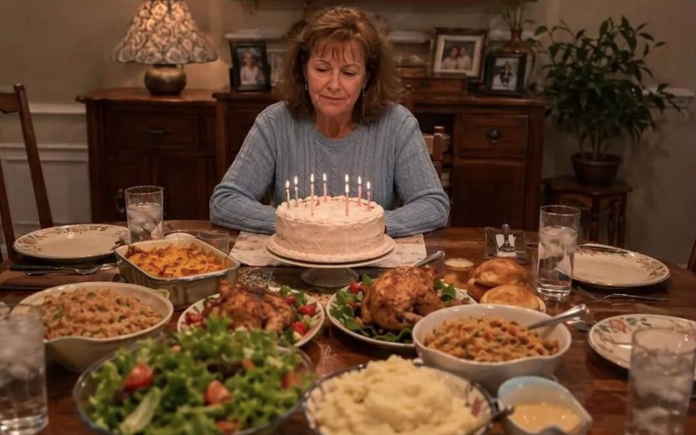
But sitting there at 60, surrounded by the six people I had once raised under one noisy roof, I realized something.
Maybe the greatest reward wasn’t having children who never left.
Maybe it was having children who eventually found their own way—and still remembered how to come home.
For the first time that night, I wasn’t counting the empty chairs.
I was counting the people sitting in them.
And finally, my table wasn’t empty anymore.