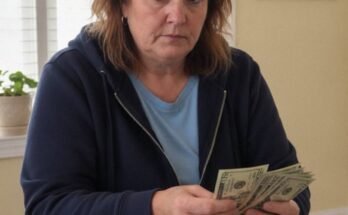
Sarah was a bank manager whose husband I had once helped during a serious medical emergency. She knew enough about my family to understand that I wasn’t calling her at dawn for something ordinary.
Before sunrise, she met me at her branch.
I showed her the recorded voicemail.
The hospital information.
The banking details.
The credit-card statement.
The location history.
She listened without interrupting.
Then she looked at me and said, “What do you want to do?”
For the first time, I knew exactly what I wanted.
I wanted out.
Not temporarily.
Not until the next emergency.
Completely.
At 6:10 a.m., my family walked into the bank.
They still smelled like expensive food and wine.
My mother was carrying the same expression she had used on the phone—fearful, exhausted, desperate.
“Mia needs the money,” she said.
I looked at her.
“No, she doesn’t.”
The room went silent.
I placed the documents on the conference table one by one.
The hospital verification.
The recorded message.
The credit-card statement.
The information proving they had never been at the hospital.
Mom’s face changed first.
Then Mia’s.
Gary stared at the paperwork.
“You followed us?” Mia asked.
“No,” I said. “You lied badly.”
My mother began crying.
“You don’t understand.”
“I understand perfectly.”
For years, I had paid their rent when they fell short.
Covered credit cards.
Helped with unexpected expenses.
Delayed my own plans.
Built my savings while knowing they considered that money available to them whenever they created a convincing enough emergency.
I had paid my insurance.
Protected my savings.
Started a small investment account.
Planned for a future mortgage.
Thought about retirement.
Thought about building an estate someday.
And every time I tried to move forward, another family crisis pulled me backward.
I wasn’t doing it anymore.
I had prepared one final document.
It wasn’t a gift.
It wasn’t another loan.
It was a formal agreement ending their financial expectations.
They would have no claim to my income, my property, my savings, or my time.
I also offered them $5,000—not because they deserved it, but because I wanted the immediate financial issue settled without another call.
Gary signed first.
My mother signed next.
Mia resisted.
Then she looked at the documents again and realized something she had never believed before.
I was serious.
She signed.
For the first time in my life, I watched my family walk away without wondering how I was going to fix whatever happened next.
There was no panic.
No guilt.
No frantic calculation.
Just silence.
And strangely, that silence felt peaceful.
The following months were different.
I moved into a brighter apartment.
I enrolled in the nursing bridge program I had postponed for years.
I started taking watercolor classes at a community center.
I bought small things without calculating whether I would need the money later for someone else’s emergency.
My phone became quieter.
My savings stayed where they belonged.
And for the first time, my future felt like something I was allowed to build for myself.
Months later, a stranger sent me a message.
Your mother has been taken to the hospital. She wants you to call.
I stared at the screen for a long time.
The old guilt returned immediately.
What if this time it was real?
What if she actually needed me?
What if something terrible had happened?
I felt the familiar pressure in my chest.
Then I placed the phone facedown beside my unfinished watercolor.
Maybe the emergency was genuine.
Maybe it wasn’t.
And that uncertainty hurt.
But I had finally learned something that took me years to understand.
Love does not require you to destroy yourself every time someone calls.
And being someone’s daughter does not mean becoming their bank account.
I picked up my brush.
For once, I let the phone keep ringing.
And I kept painting.