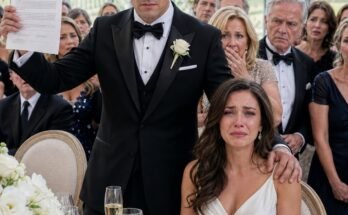
Fifteen years after my father threw me out of his home, I saw him again at my younger sister’s wedding.
I had spent fifteen years imagining that moment in different ways.
Sometimes I imagined myself walking into the room confidently, proving that I had built a life without him.
Other times, I imagined turning around before he ever saw me.
But I never imagined him looking me directly in the eyes, raising his glass of Bordeaux, and saying the words that had once been capable of destroying me.
“If it wasn’t for pity, no one would have invited you.”
He said it loudly enough for people nearby to hear.
Then he smiled.
I took one slow sip of my wine and smiled back.
What my father didn’t know was that my sister, the bride, had been waiting for this moment for years.
And before the night was over, she would take the microphone in front of 250 guests and reveal something about my life that my father had never bothered to learn.
Something that would make the entire ballroom turn toward me.
But that evening didn’t begin with applause.
It began with humiliation.
The first insult came before dinner.
I was standing beside the cocktail tables at Greenfield Country Club with a glass of Pinot Noir in my hand when my father approached me.
Gerald Ulette looked older than I remembered.
His silver hair was thinner. There were deeper lines around his eyes.
But somehow, he had not become gentler.
He was wearing an expensive dark suit, polished shoes, and the same expression I remembered from my childhood.
The expression that suggested every room belonged to him if he stood in it long enough.
His eyes moved over my navy dress.
Then he looked toward the ballroom, where nearly 250 guests were drinking champagne beneath crystal chandeliers.
“I didn’t realize Clare’s guest list included charity cases,” he said.
I looked at him.
“Hello, Dad.”
Margaret, his wife, appeared beside him in a red dress and pearls.
She smiled.
Not warmly.
It was the kind of smile that suggested she had been waiting fifteen years for the opportunity to see whether I would break.
My father glanced back at me.
“If you embarrass this family tonight,” he said, “I’ll make sure Clare regrets inviting you.”
I didn’t answer.
Because that was the thing about my father.
Money had never simply been money to him.
It was leverage.
It was control.
It was a leash.
The apartment he had helped pay for could become a threat.
The car he bought could become something he could take away.
The wedding he was financing could become a reason to dictate who was allowed to attend.
Everything he paid for came with an invisible string attached.
And fifteen years earlier, I had cut that string.
I was twenty-two when I told him I wasn’t going to join the family insurance business.
Instead, I wanted to enter the military.
My father didn’t understand the decision.
Or perhaps he simply refused to accept that I could make a decision he hadn’t approved.
“You made your choice,” he told me.
By the end of that week, the locks on the house had been changed.
My health insurance was gone.
And photographs of me began disappearing from the walls.
It was as though I had died without actually dying.
I left with one suitcase and approximately $1,100 in savings.
I was twenty-two years old.
My younger sister Clare was fifteen.
I still remember her standing at the window of my old bedroom, crying as I walked away.
She had braces on her teeth.
She was still young enough to believe that adults could fix everything.
Neither of us knew how much damage fifteen years could do to a family.
Now she was the bride.
And she was the reason I had returned.
Her invitation had arrived without a return address.
It was handwritten.
There were only a few words.
Please come. I need you there.
I almost didn’t go.
Then I read the message again.
And again.
Finally, I drove three hours to Greenfield Country Club.
When Clare saw me, she didn’t hesitate.
She ran toward me in her wedding dress and threw her arms around me.
The beads on her Vera Wang bodice pressed into my shoulder.
She held me tightly.
“Dad doesn’t know I sent it,” she whispered.
I pulled back.
“Clare, no.”
“Margaret tried to stop it.”
“Clare…”
“Trust me.”
She grabbed both my hands.
“No matter what Dad says, please stay.”
I looked into her eyes.
And I saw something I had seen many times before.
Resolve.
I knew that look.
I had seen it in people standing beside helicopters.
I had seen it on soldiers before difficult missions.
I had seen it in people who were frightened but had already decided they were going to move forward anyway.
So I stayed.
Even when I saw the welcome board.
The Ulette Family — Established 1988.
Somehow, the family history began in the same year I was born, yet my name was nowhere on it.
Even when I found my place card at table twenty-two, near the kitchen doors.
It didn’t say:
Evelyn Ulette.
It simply said:
Guest of the Bride.
I stared at it for a moment.
Then I sat down.
During cocktail hour, Margaret made sure everyone knew who I was.
“This is Gerald’s older daughter,” she told one group of guests.
“She left the family years ago to do something with planes.”
I smiled politely.
“I’m in the Air Force.”
Margaret tilted her head.
“Right. Still just you and the uniform?”
A few people smiled awkwardly.
Nobody defended me.
Nobody corrected her.
They understood the rules in my father’s world.
Don’t contradict Gerald.
Don’t embarrass Margaret.
And above all, don’t ask why his eldest daughter had spent fifteen years outside the family.
At dinner, my father made sure everyone heard his version of the story first.
He stood at table one with a glass of Bordeaux in his hand and began talking about loyalty.
Family.
Responsibility.