The smaller envelope felt heavier than paper should.
Grandma Grace had written only one line on the front.
Open only when absolutely necessary.
I looked at Patricia standing at the podium, one hand gripping the microphone, the other pressed against the edge of the wood as if it were the only thing keeping her upright.
Her face was pale now.
Not angry.
Not smug.
Afraid.
That was how I knew.
Whatever Grandma Grace had hidden inside this envelope, Patricia had spent thirty years hoping I would never find it.
“Myra,” she said, her voice low and urgent, “don’t do this here.”
I looked around the room.
The same room where she had called me a tax benefit.
The same room where Jenna had laughed and recorded.
The same room where my father had stared at his plate while the woman who raised me tried to turn my birthday into a public execution.
“You chose here,” I said.
Aunt Helen stood near the end of the table, tears in her eyes, but her chin lifted.
“Open it,” she said softly. “Grace wanted you to know.”
So I broke the seal.
Inside were three things.
A DNA report.
A faded photograph.
And a short legal statement signed by Grandma Grace and witnessed by Theodore Whitman.
I unfolded the DNA report first.
The room was so quiet I could hear the chandelier crystals moving faintly above us.
“This test was done when I was two years old,” I said.
My voice sounded calmer than I felt.
“It confirms that Marcus Anderson was my biological father.”
Several people looked at each other.
Someone whispered, “Marcus?”
Patricia closed her eyes.
My father covered his mouth.
I turned toward him.
“Marcus was your brother,” I said.
Richard nodded slowly, his face gray.
“My older brother,” he said, barely above a whisper.
That was the first time in thirty years I had ever heard my father say that name out loud.
Aunt Helen stepped forward.
“Marcus was Grace’s firstborn son,” she said. “He struggled. The family didn’t like talking about him. After he died, Grace begged Richard and Patricia to take in his daughter.”
Her eyes met mine.
“You, Myra.”
The floor seemed to shift under me.
I had spent my entire life believing I was some outside child Patricia had tolerated.
But I had not been brought into the Anderson family.
I had been born into it.
Grandma Grace had not loved me out of charity.
She had loved me because I was her granddaughter.
Her blood.
Marcus’s child.
I looked down at the faded photograph in my hand.
A young man sat on the grass in Grandma Grace’s garden, holding a baby wrapped in a pale yellow blanket. He had dark hair, tired eyes, and a crooked smile that looked painfully familiar.
My smile.
On the back, in Grandma Grace’s handwriting, were the words:
Marcus and Myra. My two greatest loves.
1994.
My hands started shaking.
Not from fear this time.
From grief.
From recognition.
From thirty years of missing a person I had not even known I was allowed to miss.
I held the photo against my chest for a moment, then placed it on the table where everyone could see.
“This is my father,” I said.
No one spoke.
Then I opened the legal statement.
Grandma Grace had written it plainly, almost brutally.
I, Grace Anderson, confirm that Myra Anderson is the biological daughter of my late son, Marcus Anderson. I requested that Richard and Patricia Anderson raise her after Marcus’s death. It was my deepest regret that Patricia treated this child as an obligation instead of family. For this reason, and because Myra is the direct descendant of my bloodline, I leave the Anderson estate to her.
I lowered the paper.
Patricia’s mouth twisted.
“She was manipulated,” she said suddenly. “Grace was old. She was sentimental. That house was supposed to stay with the family.”
“It is staying with the family,” Aunt Helen said.
Patricia snapped toward her.
“With Myra,” Helen continued. “Marcus’s daughter.”
Jenna looked stunned, still holding her phone at her chest.
“So she’s not just adopted?” she whispered.
“No,” I said. “I was adopted because my father died and my grandmother wanted me kept in the family.”
Then I looked at Patricia.
“And you knew.”
It was not a question.
The way her eyes flickered told me everything.
My father stood slowly.
“Pat,” he said. “Tell the truth.”
She turned on him.
“Don’t you dare.”
His face crumpled in a way I had never seen before.
“Tell her,” he said. “She deserves that much.”
For the first time all night, Richard Anderson looked like a man who had finally grown tired of being afraid.
Patricia stared at him, then at me, then at the forty guests who had become witnesses to more than she ever intended.
Her polished mask cracked.
“Yes,” she said. “I knew.”
A sound moved through the room.
Not a gasp.
Something colder.
Patricia lifted her chin anyway.
“I knew Marcus was your father. I knew Grace wanted you raised here. But do you have any idea what that felt like for me?”
I said nothing.
“She brought you into my house like some sacred little ghost,” Patricia said, her voice rising. “Everything was about Marcus. Poor Marcus. Gifted Marcus. Lost Marcus. And then you looked like him. Smiled like him. Grace looked at you like you were the only thing that mattered.”
Aunt Helen’s voice turned sharp.
“You were jealous of a child.”
Patricia’s face hardened.
“I was tired of living under the shadow of a dead man.”
The room went still again.
There it was.
The truth beneath every pause, every slight, every birthday forgotten, every introduction where she separated Jenna from me like I was something borrowed.
Patricia had not disliked me because I was adopted.
She had disliked me because I belonged too much.
Because Grandma Grace saw Marcus in me.
Because the estate, the history, the bloodline she had tried to decorate herself into — all of it led back to a child she never wanted to acknowledge.
I looked at my father.
“You let her do this.”
Richard flinched.
“I know.”
“For thirty years.”
His eyes filled.
“I know.”
“You watched her make me feel like an outsider in my own family.”
“I was a coward,” he whispered. “I told myself keeping peace was protecting everyone. But it only protected me.”
That was the first honest thing I had ever heard him say.
It did not fix my childhood.
It did not erase every holiday dinner where I sat silently while Jenna shined beside Patricia.
But truth has weight.
And once it lands, the room can never pretend it did not hear.
Patricia grabbed the edge of the podium.
“This will can be contested,” she said. “I will contest it. I maintained that house. I hosted every event. I kept that family name alive.”
“You kept yourself visible,” Aunt Helen said. “That isn’t the same as keeping a family alive.”
I picked up the will.
“The document is valid. The attorney has video, witnesses, and medical verification of Grandma Grace’s state of mind. You can fight it if you want.”
I looked directly at Patricia.
“But tonight, in front of everyone, you gave forty witnesses a reason to understand exactly why she left it to me.”
For once, Patricia had no answer.
Jenna slowly lowered her phone.
Her face was no longer amused.
“Mom,” she whispered. “You planned this because of the house?”
Patricia looked at her daughter.
Something passed between them.
A recognition Jenna did not want.
My sister had laughed at me because she thought she was standing beside power.
Now she realized she had only been standing beside panic.
“Jenna,” Patricia said. “Don’t be ridiculous.”
But Jenna stepped back.
“No,” Jenna said quietly. “You told me she would run. You said if she was humiliated enough, she’d disappear.”
The room erupted.
Patricia turned white.
I felt the last piece click into place.
That party had never been a celebration.
It had been a strategy.
If I ran from the room, ashamed and broken, Patricia could use the fallout to paint me as unstable, ungrateful, unfit to handle the estate. She wanted witnesses, not for my birthday, but for my collapse.
The only problem was that Grandma Grace had known her better than anyone.
And she had prepared me for exactly this.
I gathered the documents carefully and returned them to the envelope.
Then I looked at the guests.
“I’m sorry you were brought here under false pretenses,” I said. “I thought this was my birthday dinner.”
A few people lowered their eyes.
Mrs. Patterson, one of Grandma Grace’s oldest friends, stood near the far end of the table.
“It still can be,” she said.
Patricia gave a bitter laugh.
“Oh, please.”
Mrs. Patterson looked at her coldly.
“Sit down, Patricia.”
The room went completely still.
Patricia blinked as if no one had ever spoken to her that way.
Mrs. Patterson continued, “Grace loved that girl. We all saw it. And many of us should have said something years ago.”
Another guest nodded.
Then another.
Aunt Helen came to my side and placed one hand on my shoulder.
“You are not alone anymore,” she said.
I did not realize how badly I needed to hear that until I felt my eyes burn.
Patricia looked around and saw it happening.
The room slipping away from her.
The sympathy she expected turning into disgust.
The people she had invited to watch my humiliation now watching hers.
Her hand flew to her purse.
“This is absurd,” she said. “I will not stand here and be attacked.”
I said softly, “That’s what you expected me to do.”
She glared at me.
Then she left.
Her heels struck the marble floor fast and uneven.
Click.
Click.
Click.
The restaurant door opened.
Then closed.
Jenna stood frozen for a few seconds, tears sliding down her cheeks. She looked at me like she wanted to say something, but the words were too tangled.
Then she ran after Patricia.
My father remained.
For the first time in my life, he came toward me without looking away.
“Myra,” he said, his voice broken. “I failed you.”
I swallowed.
“Yes.”
He nodded like he deserved that.
“I don’t expect forgiveness.”
“Good,” I said quietly. “Because I don’t have it ready.”
Pain moved across his face, but he accepted it.
“I’ll tell you everything about Marcus,” he said. “Whenever you want. Whatever you ask.”
I looked down at the photograph of my father holding me.
The man in the picture looked young, fragile, hopeful.
“He loved me?” I asked.
Richard’s face crumpled.
“More than anything,” he said. “Even at the end. Especially at the end.”
That was when I cried.
Not the way Patricia wanted.
Not humiliated.
Not broken.
I cried because I had spent thirty years starving for a history that had been mine all along.
Aunt Helen wrapped her arms around me.
Around us, the room softened.
Someone began singing “Happy Birthday” quietly.
At first, it felt strange.
Then Mrs. Patterson joined.
Then Lucas, my closest friend from work, who had been standing near the back because he had insisted on coming “just in case.”
Then more voices.
Soft.
Awkward.
Human.
I laughed through tears when the cake came out again.
This time, when I blew out the candles, I did not wish to belong.
I already did.
One week later, Theodore Whitman filed the final estate documents.
Patricia tried to challenge the will.
She failed before the case even gathered speed.
The video of Grandma Grace signing the documents was clear. The witnesses were credible. The medical statement was strong. And thanks to Patricia’s own performance at The Sterling, no one doubted why Grandma Grace had protected me.
Patricia moved out of the Anderson estate within a month.
She did not go quietly.
There were emails. Threats. Accusations. Long messages about betrayal and entitlement.
I did not answer them directly.
Everything went through attorneys.
For the first time in my life, Patricia did not get to walk into my peace whenever she wanted.
Jenna called me three weeks after the party.
I almost let it go to voicemail.
Then I answered.
“Please don’t hang up,” she said.
I stayed silent.
“I’m not going to pretend I was innocent,” she continued. “I laughed. I recorded. I helped her.”
“Yes,” I said.
Her voice broke.
“I thought if Mom loved me more, it meant I was safe. But I think she just taught me to be cruel so I wouldn’t notice she was using me too.”
That was not an apology, not fully.
But it was the first honest thing Jenna had ever given me.
We met at a coffee shop a week later.
She looked smaller without Patricia beside her.
“I don’t know how to be your sister,” she admitted.
I stirred my coffee.
“Then don’t start there.”
She looked confused.
“Start by being someone who tells the truth.”
That was where we began.
Slowly.
Carefully.
With distance.
Richard and I began again too, though that was harder.
He told me about Marcus.
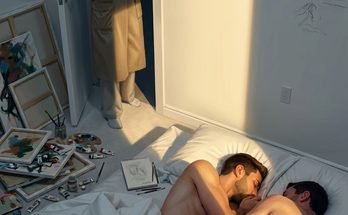
My father had been an artist. Brilliant, restless, wounded. He had struggled after a car accident left him in chronic pain. The family buried his story because it was easier to call him a failure than to admit they had failed him.
Grandma Grace kept his paintings hidden in her bedroom closet.
The first time I visited the estate as its owner, I went straight there.
The house was quiet.
Without Patricia’s flowers and polished silver trays, it felt less like a stage and more like a memory waiting to breathe.
Grandma Grace’s room still smelled faintly of lavender and old books.
In the back of her closet, behind winter coats, I found a cardboard box.
Inside were photographs.
Marcus as a boy with paint on his hands.
Marcus laughing beside Aunt Helen.
Marcus holding me as a baby, his cheek pressed to my forehead.
And under the photos, wrapped in brown paper, were three small paintings.
One was of Grandma Grace’s garden.
One was of a Boston street after rain.
The last one was of a baby sleeping in yellow light.
On the back, he had written:
Myra, before the world tells her who to be.
I sat on the floor and sobbed until my chest hurt.
Not because I had lost Patricia.
Because I had found him.
Months later, I turned one wing of the estate into the Marcus Anderson Memorial Studio, a scholarship program for young artists aging out of foster care.
I knew what it felt like to grow up believing your place in the world depended on someone else’s permission.
I wanted those kids to know better sooner than I did.
At the first scholarship ceremony, a seventeen-year-old girl named Maya stood beside one of her charcoal drawings and asked me, “Did you ever feel like you didn’t belong anywhere?”
I looked at her and thought of the birthday table.
Patricia’s microphone.
Jenna’s laugh.
My father’s silence.
Grandma Grace’s envelope.
“Every day,” I said. “Until I stopped asking the wrong people to let me in.”
Maya nodded like she understood.
“Does it get easier?”
“Yes,” I said. “But first it gets honest.”
The Anderson estate changed after that.
The dining room where I once felt invisible became a place for scholarship dinners.
The garden where Grandma Grace used to hold my hand became a place where young artists painted in the summer.
The parlor where Patricia performed her perfect life became a gallery for Marcus’s work.
I did not erase the past.
I gave it a better use.
Patricia never returned.
I heard from Richard that she had moved to a condo outside the city and stopped attending most of the social events she used to rule. Some friends drifted away. Some stayed. People like Patricia always find someone willing to believe their version.
But she no longer had access to me.
That was enough.
Jenna and I remained complicated.
Some months we talked.
Some months we didn’t.
But once, on my thirty-first birthday, she sent me a message.
I know I don’t deserve to say this, but happy birthday. I hope this one feels different.
I stared at it for a long time before replying.
It does.
Richard visited the estate that spring.
He stood in front of Marcus’s paintings for almost an hour.
Then he turned to me and said, “Your grandmother would be proud of what you did with this place.”
I looked around the room.
At Marcus’s art.
At the scholarship letters.
At the sunlight coming through the windows Patricia used to keep covered with heavy curtains.
“No,” I said softly. “She would be relieved.”
Because that was what her envelope had really given me.
Not a house.
Not revenge.
Not even money.
It gave me proof.
Proof that I had not imagined the cruelty.
Proof that I had a father.
Proof that Grandma Grace had seen me, loved me, and planned for the day I would finally need to stand.
On the anniversary of that birthday dinner, I went back to The Sterling.
Not for another party.
Just dinner with Aunt Helen, Lucas, Richard, and three of the scholarship students.
We sat near the windows overlooking Boston.
No ribbon-wrapped chair.
No microphone.
No performance.
Just warm food, real laughter, and people who did not require me to shrink.
At the end of the night, the server brought out a small cake.
One candle.
I looked at the flame for a long time.
Aunt Helen smiled.
“Make a wish.”
I thought about it.
Then I shook my head.
“I don’t need to.”
Because for the first time in my life, I was not wishing to be chosen.
I had chosen myself.
And that was enough.
Later that night, I returned to the estate and placed Grandma Grace’s envelope in a glass frame beside Marcus’s first painting.
Not because I wanted to live inside that moment forever.
But because I wanted to remember what it taught me.
Some people will spend years convincing you that you are lucky to be tolerated.
They will call their cruelty honesty.
They will call your pain sensitivity.
They will invite a room full of people to watch you break.
But truth has a way of waiting.
Quietly.
Patiently.
Inside a sealed envelope.
Inside an old photograph.
Inside the one person who loved you enough to prepare you for the day you would finally stop begging for a place that was already yours.
I still think of Grandma Grace often.
In the garden.
In the studio.
In the rooms that no longer feel cold.
And sometimes, when sunlight moves across Marcus’s painting of me as a baby, I hear her voice as clearly as I did that night.
You belong here more than you know.
Now I do.